

Most everyone has read, seen, or experienced Charles Dickens’ A Christmas Carol in some form or another since childhood. The tale will likely remain a cultural touchstone in the English-speaking world for centuries. Any further discussion of Carol serves little purpose at this point (it must be read and reread, often) but I believe many well-read people, who may even know of the existence of the other Dickensian Christmas works, may come to appreciate one or more of these unloved Christmas novellas, as much as another turn through a Skipping Christmas or Little Women.
“The Chimes”

The year following the release of Carol, 1844, saw the release of The Chimes: A Goblin Story of Some Bells that Rang an Old Year Out and a New Year In. While The Chimes begins on New Year’s Eve, the moral themes and rich vs. poor dynamics from Carol are very much in play. The book was well-received, but it was perceived as a much more radical expression of Dickens’ message, as he really leaned in on the immorality of inequality at the time.
The Chimes is a story of an elderly man, Trotty, who is ultimately unsure of whether or not mankind is inherently beastial in nature, and undeserving of salvation. He is drawn to a church tower and comes into contact with the spirits and goblins of the bellchamber, who inform him that he is already dead, having fallen from the tower. The spirits admonish him for losing faith in mankind’s inherent drive toward moral and ethical nobility, and Trotty is shown visions of his children and niece suffering through life to the point that his daughter considers killing herself and her daughter to end her suffering. At which point, Trotty begs for release, and is able to touch his daughter and prevent her from plunging herself and her child into the river.
Unlike Carol, The Chimes ends with questions regarding the future of Trotty and his lineage. The reader is left imagining that the family must still likely suffer dearly, if they’re to make it through the tough times of life, although they now have a spiritually stronger patriarch to guide them.
“The Cricket on the Hearth: A Fairy Tale of Home”
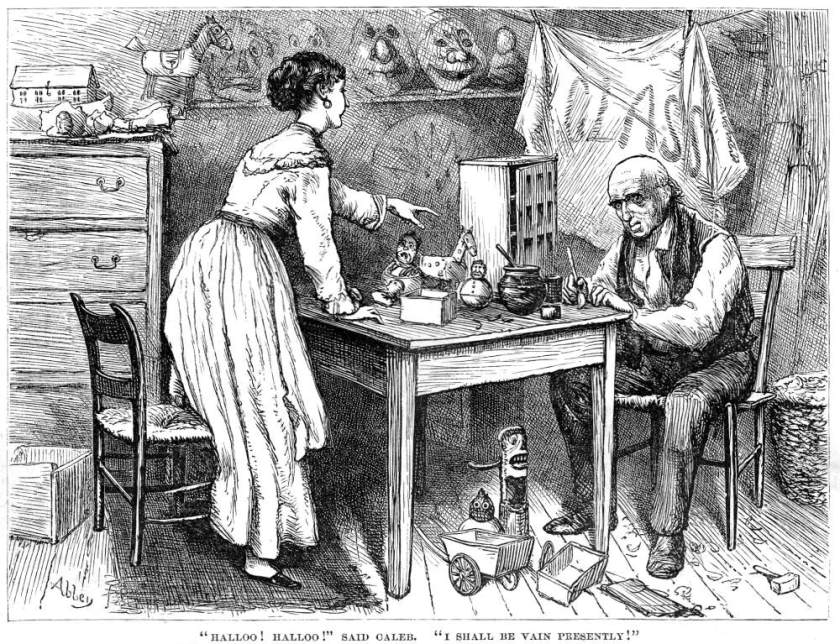
1845 saw the release of The Cricket on the Hearth: A Fairy Tale of Home. This novella is a departure from the sermonizing of its predecessors, focusing more on sentimentality and the Victorian domestic ideal of home.
The Cricket is a proper fantasy story, with a cricket who acts as a guardian angel to John and his young family. An elderly stranger comes to stay with John and his family, and the antagonist, Tackleton, a Scrooge-like miser, is bent on convincing John that his wife has cheated on him with his mysterious lodger. Meanwhile, Tackleton has pressured a girl to marry him while she loves another. John is pushed to the brink by Tackleton’s accusations, and even asks his wife for a divorce. The conflicts resolve with the unmasking of the mysterious lodger, while Tackleton has a Scrooge-like turn of character and assists in the resetting of John’s happy home.
“The Battle of Life: A Love Story”

The following year, 1846, saw yet another holiday release from Dickens: The Battle of Life: A Love Story. The Battle is the only of the five Christmas books that has no supernatural elements. The tale follows the romantic relationships of two sisters, and is likely Dickens’ most Austenian work. The end twist is reminiscent of the reveal from The Cricket.
I would not recommend The Battle for Christmas reading, as it’s the furthest of the five from my own sentiments of what constitutes a ‘Christmas story.’
“The Haunted Man and the Ghost’s Bargain, A Fancy for Christmas-Time”
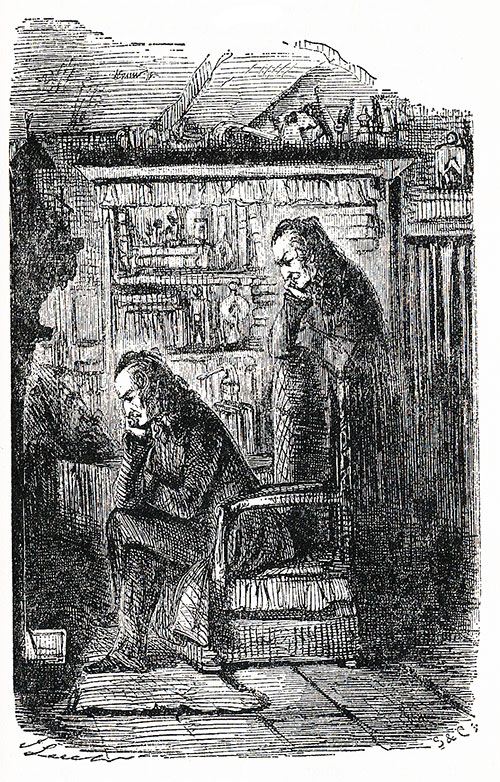
Dickens’ final Christmas book was released a full two years following The Battle, in 1848. The Haunted Man and the Ghost’s Bargain, A Fancy for Christmas-Time is a return to the form and formula of the first two novellas. Redlaw is a teacher who can’t help but pore over the past, continuously contemplating his griefs and regrets, and cursing all of the people who’ve wronged him in his life. He infects his students and friends with his bitter, angry character, and is an all-around nasty man.
A spirit visits Redlaw in an attempt at stemming the tide of Redlaw’s intense angst and rage over the loss of his sister, and other woes. The ghost is his proper spiritual double, or the higher, more virtuous version of himself which he has long neglected. The pair converse and the apparition asks Redlaw if he’ll let the ghost help him forget his most painful memories. Redlaw agrees, and is cured of the memories, and is also given the gift of helping his friends and students forget the past. However, while Redlaw and the people whom he ‘treats’ have forgotten specific painful incidents in their lives, they now feel a misplaced, unjustifiable anger, as if Redlaw’s anger had really been a sickness.
Redlaw realizes the damage he has wrought and attempts to pray it away on Christmas Eve. Christmas Day sees Redlaw’s prayers answered, as he and even people who have wronged him ask each other’s forgiveness.
My recommendations
I’d recommend reading The Chimes and then The Haunted Man this Christmas season, and if you enjoy those stories, to move onto The Cricket. However, I’d read Little Women again before I’d read The Battle.
 If you’ve gotten your fill of Dickens and are looking for something more contemporary, I’ve written a short Christmas book called Carol for a Haunted Man. It is very much in the spirit of Dickens’ Christmas tales, and something I’d describe as a new Dickensian-style Christmas story, filled with nostalgia, moral sentiment, and an erudite apparition.
Here’s the description from the back cover:
“As some authors dream into the history of their town or city, Jacob Martin sought to reestablish the comforts of his childhood by moving back to the street where he grew up. Lost in life, newly divorced, and separated from his three young kids, Jacob is driven to write a book worth remembering, as a way of giving his life a new lasting purpose and meaning.
“Finding himself at a standstill on the novel, a lonely recluse during the holidays, Jacob manages to connect with an attractive woman, and befriend an older man from his distant past, an author like himself. As Jacob soon discovers, nostalgia can be a healthy distraction, or it can be the noose by which one hangs.
“CAROL FOR A HAUNTED MAN is the tale of a daunted man’s will to succeed in the face of despair. It is a novella inspired by, and in homage to, the Christmas stories of Charles Dickens.”





 Cemetery Gates Media