Bloodlust Boulevard

Uncategorized

by Greg Sisco

Loraine took her hands out of her pockets just long enough to zip up her leather jacket before plunging them back in. Jesus, it was brisk. Good brisk. Been too long brisk. Finally feels like fall at the end of a long summer brisk. But still, Jesus.

She would’ve driven, but chances of adult beverages seemed high, and she didn’t have the funds to justify an Uber, especially when the bus stop was only a quarter mile from the house, but damn, she’d have brought a hat and scarf if she realized it was going to be like this. The fake blood was freezing to her skin, the stop sign she’d cut to look like it was lodged in her neck felt like ice, and wind pierced the jacket where she’d torn it to look like the stop sign went through. Here on Elm Springs Parkway—colloquially Bloodlust Boulevard—it always seemed colder than it was in the rest of the city.

Loraine smirked. Of course it was colder on Bloodlust Boulevard. It was only right.

She took a deep breath and exhaled hard, trying to let the cold out of her as she took in the decorations. What a place to walk alone. Ominous lights, cobwebs, carved pumpkins with red lights for eyes, bloody axes stuck in tree stumps, entrails hanging from gutters. She’d wanted to come to a party on this street ever since trick-or-treating here as a little girl. Even driving or walking the street each year put a smile on her face. Every town had a Candy Cane Lane, it seemed to Loraine, but she thought herself blessed to live in a town with Bloodlust Boulevard.

Cold though. Always cold. Some anomaly in its placement among the hills? A trick of the mind brought on by the creepy atmosphere? A little of both?

She shivered, shrugged, and walked up the driveway to Megan’s house.

#

“Did you see the one with the heads on the fenceposts?” asked a man with a pair of scissors stuck in one eye like he tripped while running with them.

“No, was that out this way?” a woman in a burnt blouse asked, pointing with a crispy, disfigured hand.

“Other way,” said Megan, a half dozen knives sticking out of her back. “We’ll go look after dark. It’s even better. There are lights on the fenceposts that shine through the eyes and mouths.”

Loraine listened, hoping a few beers would build up her tolerance to the cold enough to go out with them.

The costume theme was “Recently Deceased” and not one guest disappointed. Everybody put in thought, worked hard, and appeared authentic, some to the point that it was hard to even look at them. Megan had stressed the message that this was a party on Bloodlust Boulevard, that everybody would get into the spirit, and anyone who didn’t put in their best effort was sure to be the weak link. Loraine was glad she’d listened.

Her phone vibrated.

Shit. Mom.

Loraine told herself, after she woke up with the hangover to end all hangovers, that she’d get around to this unpleasant conversation before the party, but apparently she’d gotten carried away. She thought of ghosting Mom but decided it was cruel under the circumstances and would only serve to weigh on her mind. She pounded the rest of her beer, grabbed another, and stepped out on the back porch.

#

“Where are you? Are you okay?” Mom was asking frantically. Loraine could hear her hyperventilating.

“I’m fine. I got home late. I went to sleep.” That was technically true, though last night was a blur. Loraine remembered she’d had dinner with a Tinder date, then they’d gone for what was supposed to be a couple drinks but turned into way too many, and her memory went blank somewhere between then and morning.

“You promised me you’d call when you got home. Do not pretend I’m overreacting.”

“Mom, I’m almost thirty. You can’t have a panic attack over every little thing.”

“You are twenty-four, and even if you were almost thirty, there’s no age limit on getting killed by a stranger you met on the internet.”

“Well, I lived. I’m sorry I forgot to text you.” she thought of a lie. “I lost my phone in the couch cushions and it took all day to find it.”

“Honey… When you say you’ll text, I need you to do it. I freak out if you don’t.”

“I know.”

Mom breathed for a minute, then asked, “Are you still going to that Halloween party?”

“Yep. On my way. Already late.”

“You absolutely promise to text me when you get home safe, right?”

“Yes, Mom. I promise.”

She shuddered in the cold, drank the rest of her beer, and went in for another.

#

By her sixth beer, she’d forgotten the unpleasantness with Mom. By her eighth, she was having a good time. By her tenth, even better.

They went out and marveled at the realistic heads stuck on the neighbor’s fenceposts, the eyes and mouths lit up like jack-o-lanterns. She had the stomach to touch one just long enough to gross herself out at how realistic it felt. People trickled back into Megan’s house and so did she.

“Holy shit! Loraine? I thought that was you!” said someone from behind her on the driveway. She turned to see a tall man with a tire tread across his face.

“Um… Hi,” she said, unable to recognize him through the makeup.

“It’s Mason. From Tinder? We went out last night?”

“Oh! Oh…” she gave him a hug, but she had a strange feeling for some reason. “Weird.”

“Double weird,” he said. “We both came as road deaths.”

That was it. That was the strange feeling.

“Well, should we go in for a—?” Loraine started, but the question was cut short by screams, lots of them, from the backyard.

#

By the time anyone found the fire extinguisher and put out the flames, much of the flesh had been taken off the woman’s upper body and she was convulsing in the grass. People shouted orders over one another. “Call 911!” “Give her space!” “Roll her on her back!”

Loraine called 911 from her phone, running into the house to get away from the screams and commotion so she could hear.

“We need a wet rag,” someone in the house was saying. He was digging through materials at a sewing table.

“I’m calling the paramedics,” Loraine told him.

“Here!” said the man, picking up a pair of scissors. “We can strip some of these materials and—” he stumbled and fell forward, the scissors plunging deep into his right eye socket.

Loraine screamed.

Then someone in the kitchen screamed.

Loraine dropped her phone and turned. Megan was face down on the floor. A crazed man was sticking knives in her back and others were trying to pull him off.

Loraine couldn’t breathe. She had the peculiar realization that she couldn’t remember how she knew Megan, where they’d met, why she was at this party.

“Something’s wrong!” said Mason, grabbing her hand. “We’ve got to get out of here.”

“Wait…” she whispered, but he was already dragging her.

The drunk haze that hung over last night lifted. She could see it in pieces now. The date. The bar. The motorcycle.

“Get on!” said Mason in the front yard, kickstarting his Harley.

Loraine tried to protest.

“Come on!” He shoved her onto the seat behind him.

She was shaking, freezing, paralyzed. Not just from the cold. From the fear. From the deja vu.

“Hold on!” said Mason, twisting the throttle.

They’d barely been riding thirty seconds when when she saw it approaching. The stop sign. The headlights. The truck.

“Stop…” she choked out in a whimper, then louder, “Stop!!”

Mason hit the front brakes hard. They both went over the handlebars—him toward the truck, and her toward the stop sign.

#

Lucy crossed her arms hard. It was freezing, and in a few minutes the sun would go down and it would be even colder. She should’ve gotten a ride. It was never this cold on Halloween. Then again, it always seemed cold on Bloodlust Boulevard.

Her shark bite makeup was freezing to her and the bikini offered no warmth. What the hell was she thinking coming out here half-naked?

She checked the address on her phone, then looked at the houses nearby. Hay bails with body parts in them. Human heads on fence posts. Great decorations. No goddamn street numbers.

She whimpered. She had to find this place, to get in, get a drink, and warm up.

“You looking for Megan’s party?” a voice called from up the street.

Lucy turned in relief to where a woman about her age was standing in a leather jacket with a stop sign lodged between her shoulder and neck. It was gruesome, violent, very real. As she ran up the driveway to meet her, Lucy was thankful she’d worked so hard on her shark bite.
Hallows Harvest

Uncategorized

by Laura Keating

“How about we play a game? Does anyone remember any games?”

The group sat in uncomfortable silence staring at the woman who’d spoken as the jack-o’-lantern Minni had carved earlier flickered and grinned wickedly. She hadn’t felt much like carving it, but it was necessary.

“We could play charades,” the lady tried again. “Or murder in the dark – the one where someone winks and if you see it you … die.”

It was raining outside, had been all night. It was hard to tell how late it was, how close to sunrise. The candle in the pumpkin had begun to sputter when Minni moved the curtain to peek outside.

A hand squeezed her shoulder and drew her back from the basement window. The building above had long ago burned away. Rain dripped from the splintered, tarpaulin-patched floorboards above onto the corner of the old mattress, soaking it. Four grown-ups sat huddled together on it. Three more hunched in the corner, staring at her, their eyes wide and scornful. Minni lowered her head and muttered an apology.

“Keep away from that,” said one of the men on the mattress, anxiously pulling on fistfuls of his blonde beard. She sat down next to him. He was younger, like her, but not young enough to be of any use. It hadn’t taken long to realise that he resented this fact. He glared out at the grey predawn light.

“The children,” said another man, also bearded but whiter. “They should have been back by now.”

“Will everyone just shut up,” hissed the younger man. Brad, Minni thought his name was, or Darren. She couldn’t remember. He was as unwashed as the rest of them, but with fewer lines on his face to fill with dirt he looked almost clean. Under the oversized pink ski-jacket he had picked up somewhere he still wore what must have been, at one time, a very expensive suit. His shoes were soft and black, but the toe flapped on one like a hungry mouth. The words Upper-Middle Management floated through her mind . . . but she couldn’t quite remember what that meant. That world seemed too long ago, the time before – but she couldn’t think about that now. She spent so much time trying to forget. It was better that way.

Minni curled her knees to her chin and began rocking herself on the mouldy mattress.

But she could not forget. It had been fun once, hadn’t it? Plastic masks and cheap capes; armour bought at big stores with bright lights.

Armour? No, it had not been that. Not then.

Costume. That was the word. A different sort of harvest back then.

They waited in the dim of the basement for the children to return from the harvest.

“Pin the tail on the donkey,” the older lady tried again. “Or blind man’s bluff? We could move that mattress back, chase each other around blindfolded.”

“I’m begging you to shut the fuck up,” said maybe-Brad.

Only the young ones could venture out on the harvest night. Wearing costumes of bones, twigs and layers of mud, thin capes and oversized shoes, they could almost blend it. Their high voices could screech and hoot and chuckle with those of the Others; their clumsy gaits in their strange attire shielded their natural strides. But it was the smell (or perhaps lack of) that was their best protection. The problem was that you never knew when you’d grown up. Some would stay back, too afraid, after their tenth year; others would risk it year after year, insisting just one more year, that the greater the number the better the harvest. Many never came back.

“It’s almost daylight,” said the older man, sharing facts they all already knew. “If they’re out in the sun, then the Others will know.”

“It’ll be okay,” said Minni.

“Bobbing for apples,” the lady said, practically cackling. “Remember apples? Nature’s candy.”

“Will you shut up!”

A rock plicked down a hole at the corner of the tarpaulin. The group held their breath, eyes fixed on the hidden entrance.

A shadow wavered there.

Minni wrapped her hand around her gun. She still carried her father’s old Smith and Wesson 0.35, more out of the habit than hope. She had eleven rounds total, five currently in the chamber. She had only ever fired it once and knew it wouldn’t do any good against Them. Still, she slowly thumbed back the hammer: It would work just fine pointed the other way.

“Maybe it’s the children?” whispered the old man, so quietly. “Hello?” His voice cracked. “Kids?”

Voices, muffled yet high enough to reach them, slipped between the charred floorboards above. A woman, older than Minni, but perhaps not by much (it was hard to tell with all her teeth and right eye missing) opened her mouth in a silent shriek, before cramming her fingers into her mouth, her back heaving. Minni had not realised she had raised her gun until a hand closed gently around her wrist. She looked around. Brad/Darren stared at her. Almost imperceptibly, he shook his head. She stared back, defiantly, but at last nodded. She lowered her gun and held his hand. They watched and waited together. Her stomach growled.

Starvation didn’t wait for an opportune moment to dig in.

She needed the harvest.

No one knew where They had come from. Some said the sky; others, under the earth; some thought they had been with them all along, waiting, watching.

It didn’t matter.

Their food, which they freely dispersed to their own once a year, was more sustaining than anything Minni or anyone else had ever known. If rationed out it could last them until the next harvest.

It was all that was left, in any case.

The voices returned, a little stronger this time. Someone giggled.

Something.

A small pale hand pulled back the corner of the tarp. Half-a-dozen small, misshapen forms stared down from the early morning gloaming, underlit by the red glow of the pumpkin. Minni could not make out their faces.

Masks or faces.

“Come and join the party,” the cackling lady said. “What have you got for us, what have you got?”

She might be fast enough for one other before herself, Minni thought, and cleared her throat as more little ones, bodies swaying, limbs nimble, began to gather around the door. The young man, Brad/Darren, squeezed her hand tight. The cackling lady grinned a broken pumpkin smile.

“Trick or Treat?”

THE END

Laura Keating has been published in several anthologies and places online, including Worst Laid Plans from Grindhouse Press, various Hundred Word Horror books from Ghost Orchid Press, and Cemetery Gates. Originally from Saint Andrews by-the-Sea, New Brunswick, she now lives in Montréal, Quebec. You can follow her on Twitter @LoreKeating and discover more at www.lorekeating.com

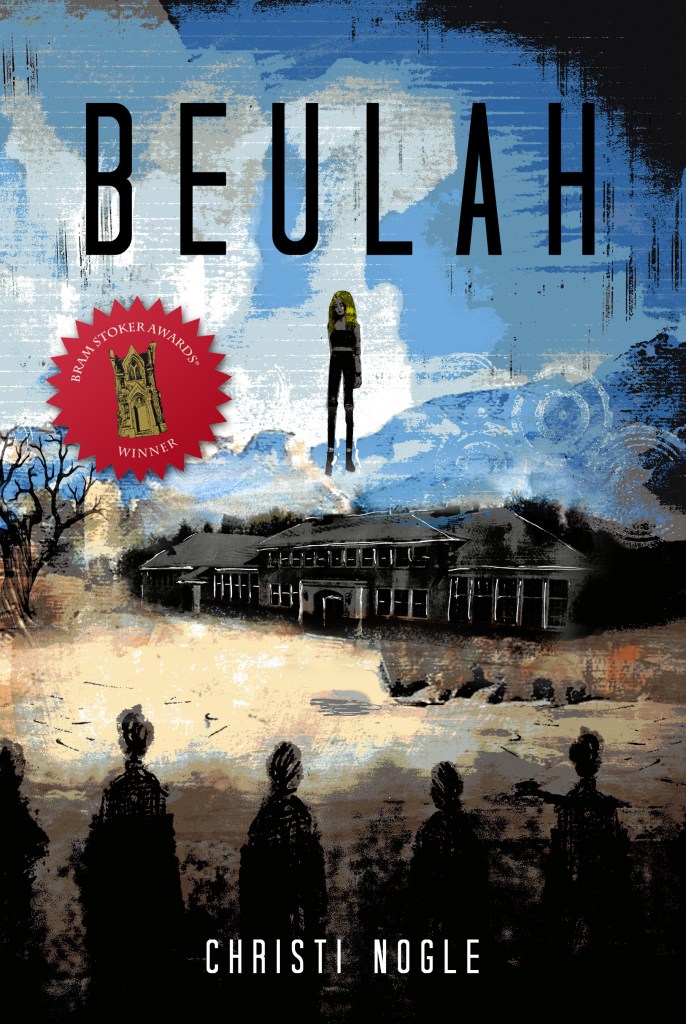
Beulah

Uncategorized
Beulah by Christi Nogle

Paperback and eBook now available here!

Winner of the Bram Stoker Award for Superior Achievement in a First Novel! Congratulations, Christi!

Beulah is the story of Georgie, an eighteen-year-old with a talent (or affliction) for seeing ghosts. Georgie and her family have had a hard time since her father died, but she and her mother Gina and sisters Tommy and Stevie are making a new start in the small town of Beulah, Idaho where Gina’s wealthy friend Ellen has set them up to help renovate an old stone schoolhouse. Georgie experiences a variety of disturbances—the town is familiar from dreams and she seems to be experiencing her mother’s memory of the place, not to mention the creepy ghost in the schoolhouse basement—but she is able to maintain, in her own laconic way, until she notices that her little sister Stevie also has the gift. Stevie is in danger from a malevolent ghost, and Georgie tries to help, but soon Georgie is the one in danger.

“With a skilled and unflinching hand, Nogle guides us through layers of time and experience in Beulah. Through the eyes of reluctantly “gifted” Georgie, we see what is usually hidden—the heartbreaking and terrifying—every rich and textured detail leading to a truly satisfying payoff. I will never forget this walk with the dead.”

— J.A.W. McCarthy, author of SOMETIMES WE’RE CRUEL AND OTHER STORIES

“Nogle, like all writers with a rare knack coupled with incredible skill and imagination, makes everything she writes look easy and effortlessly ingenious. Even the Table of Contents of her latest novel, Beulah, reflects that sense of effortless ingenuity (The beginning chapter is called “When you talk to the dead”, followed by 12 month named titles, followed by the last chapter, “When you walk with the dead”). I’ve been lucky enough to publish Nogle’s short stories twice now, and I hope to publish her work many more times in the future. My initial reaction to reading this debut novel is simply this: how in the hell could this be anyone’s first novel? It’s so assured, so masterful, so in control at every level. This is not the typical mess of even the most talented writer’s first attempt at that tricky long form. This is the work of a top tier author in top form. Anyone writing a book blurb is tempted to summarize the plot and shower the book (and writer) with hyperbolic praise. I won’t do the former, and I promise you I’m not doing the latter. Nogle has all the goods, a singularly weird imagination, a tremendous sense of pacing and voice, and a mastery of clarity and control on the sentence level. Beulah will easily prove to be one of the best horror novels (never mind debut novels) of 2022. Read it.”  

-Jon Padgett, author of The Secret of Ventriloquism 

——

Christi Nogle’s fiction has appeared in publications such as Pseudopod, Vastarien, Tales to Terrify, and Three-lobed Burning Eye. Christi teaches English at Boise State University and lives in Boise with her partner Jim and their gorgeous dogs. Follow her at christinogle.com or on Twitter @christinogle.

Signed Book Info

Uncategorized

We’re going to try to keep this updated. This page is for folks interested in purchasing signed copies from their favorite horror authors. Contact the individual author to complete your order. If a book is listed here the author has let us know they have current stock ready to ship, though some books might sell out quicker than we can change the info. If you’re a horror author and would like your book listed here contact: cemeterygatesmedia@gmail.com. Please let us know where you ship to and tell us as soon as possible when you are out of stock.

If you’re interested in Cemetery Gates’ signed books check out our store!

Elford AlleyThe Last Night in the Damned House and Other Ghost Stories, Ash and Bone: Tales of Terror, Find Us and Other Stories, In Search of the Nobility, TX Wildman. Each one is $8 and that includes shipping costs. Elford will also ship outside of the country. He can be contacted at elfordalley@gmail.com

T.J. TranchellCry Down Dark, Asleep in the Nightmare Room, The Private Lives of Nightmares, Tell No Man. Purchase from his shop. Ships to USA. International inquires can be sent to tj.tranchell@gmail.com

Kimberly Davis BassoNext Door, I’m a Little Brain Dead, Birth and Other Surprises. All titles are $20 including shipping, U.S. only at this time. Order via https://linktr.ee/KDBwrites

S. J. KrandallFear Farm No Trespassers. Cost: $13.95 for book plus $3.00 shipping. U.S. Only. Contact: sjkrandallbooks@gmail.com

The Mayor of Halloween is Missing!

Uncategorized

Softcover book now available here! Or check out Our Store for signed copies.

Gorgeous hardcover version now available here!

In the rolling hills of New York there is a quaint little village named Holiday, where a quaint little mayor named Fatz presides. Mayor Fatz is known for filling each special day of the year with fun events and unique traditions that everyone can enjoy. At the village Easter Picnic he once dressed up as a pink marshmallow chick and handed out baskets full of jelly beans and milk chocolate babies. On the Fourth of July he officiated a remote-controlled duck race at Lake MLK on water skis. Months of planning goes into each holiday activity, and the mayor makes sure that every detail has been accounted for. Mayor Fatz is more than just the mayor of a quaint little village named Holiday–he is the Mayor of Holidays!

The Mayor of Halloween is Missing! is an illustrated story book for ages 3-9 from debut author Emily S. Sullivan and artist Cat Scully. It is the story of three children who go on a quest on Halloween Night in order to find their missing mayor and save trick-or-treating.

Mayor Fatz has been gone for days and there are few clues to his whereabouts. He holds the missing key to the Holiday Room at Village Hall, where he is tasked with initiating the night’s festivities. Friends Charlotte, Jackson, and Charlie must follow the clues scattered throughout their small town and overcome their fears if they wish to find Mayor Fatz and preserve their Halloween traditions.

Author Emily S. Sullivan and Illustrator Cat Scully

Emily S. Sullivan was born in South Korea and grew up in New York. She studied Early Childhood Education at Oakland University in Michigan. She lives in Upstate New York with her husband, daughter, and darling beagle Benelli.

Cat Scully is the author and illustrator of young adult illustrated horror series JENNIFER STRANGE from Haverhill House Publishing. She has worked in middle grade, young adult, and adult illustration creating interiors and maps for clients like Random House, Scholastic, Simon and Schuster, and more. When Cat’s not working in publishing, she works in game development concept art and user interface design for The Deep End Games.

New Voices in Horror with Rowan Hill

Uncategorized

Joe Sullivan: Your Twitter bio says Aussie/Yank, and I’ve seen your volcano videos from your current living situation near Mt. Etna–so I’m extra curious what horror and dark fantasy media you grew up with and where?


Rowan Hill: Yes, it’s a little mysterious, huh? A short summary would be I was born and raised in California with my tweens and teens in Coastal Australia. With family all over, I had summers in Indonesia and the South (of America). I’ve got an adventurous side and after college, I wore out my passport and hiking boots, mostly in the U.S, Asia, and Europe, and worked a ton of odd jobs, (think everything from first-mate to ski-bum to Professor), and though I am currently in Sicily, I’ll be returning to the States soon. I was weaned on Goosebumps but had a sci-fi/ fantasy household and it’s my first love. I remember the first piece of literature to ever make my heart skip was LOTR and under the dank earth with the Barrow-wights. But we had a pretty rounded-out exposure with horror and I will never forget my dad leaving 10-year-old me alone in the rumpus room while Killer Klowns From Outerspace played. I was a teen in the Wes Craven slasher era, a magical time for youth who could go to midnight movie marathons, and I would say that was what started my affair with horror.  

When did you decide you wanted to write for professional markets? What, if anything, inspired you to send off your first submissions?

In 2019 I was in a transitionary time and free to work on my writing. After finishing a larger (now shelved) novel, I took a breather and tried to write something short and dark and randomly came upon the Kandisha Press ‘The One who Got Away’ prompt. I tried my hand at it and Jill Girardi wrote me a few weeks later and gave my first bit of praise. And as a new writer, those few words were everything to me (don’t worry, I told her so). So, I tried again and found that there isn’t a feeling quite like that acceptance high, is there?   

You have a degree in Applied Linguistics. What is your specialty? Have you pulled from your research for your fiction?

My degrees specialized in ESL (hence all the travel and living abroad) and my earlier studies often involved the cultural cues we use in language. Slang, jargon, colloquialisms, the way you can distinguish whether someone is from North or South Arkansas based on the way they say ‘bayou’. How saying ‘mate’ at an Aussie barbeque at the right moment can either greet a friend or admonish. Since I write over so many locations, I feel I absolutely have to include speech cues and cultural dialect to add authenticity. Plus, it’s just fun to add Aussie slang into anything. Have you heard Aussie blokes when they are three pints in? Hilarious.

I’m familiar with your short stories and see you’re in a few upcoming anthologies that I’m looking forward to checking out, but I imagine you’re most excited for your debut In the Arctic Sun. What can you tell us about your novella from D&T Publishing? 

First of all, thank you! I’ve been very fortunate this year with anthologies and loved them all. And yes, I am equal parts excited and terrified for In The Arctic Sun to come out. It is one of those annoying situations where too much info will ruin the climax but it’s the story of a woman living in Alaska’s Arctic Circle and currently dealing with a bad case of insomnia from the constant summer daylight. Her quiet life is further disturbed when she believes an oil company moving through her valley has woken up something beneath the frozen earth and can’t distinguish between hallucinations from exhaustion and reality. It deals with issues of isolation and what it means to be a woman alone in the wild, fighting against men and nature itself. If I had to liken it to anything, I would say The Babadook and put it in the ‘psychological creature feature’ genre. 

What writing plans do you have beyond your novella and short stories? What themes and motifs interest you in the horror genre right now?


You know what? For the last year or so, I notice I have been drawn to stories of women villains and writing them in my own works. Whether it is a lonely cattle herder in the outback or a stripper in Vegas. I believe that’s why the team at Kandisha Press is killing it. Who doesn’t love a good, vengeful woman? I often write about women protagonists who may or may not be the bad ‘guy’ and explore how they are treated in society, especially those with traumatic histories. There is probably some therapy 101 issues to be dissected with my predilection of women empowerment to the extent that I make them all into the predators, but I’ll wait til my mid-life crisis hits before I tackle them.

Additionally, as with Arctic Sun, I adore a good ‘man vs nature’ plot. I think this is because I’ve experienced a few of them myself. Deserted Slovenian woods at night? Altitude sickness among Nepalese mountains of ice? Rats running over your toes in a Bangkok alley? Nature is terrifying, and what it hides even more so. Christina Henry’s ‘Near The Bone’ was a great read this year. What are men compared to rocks and trees and terrifying beasts stalking you in the woods, am I right? For my current WIP, ‘Horror’s Daughter’, I like the idea of merging genres and I’m trying to improve my gothic prose to write a modern Southern Gothic Slasher. Like, I said prior, my family is from the Deep South and there is some darkness in that area that both saddens and terrifies me. It’s an amalgamation of the land, brimming with secret bayous and woods between farmlands, and the mentality of insular life in small-town America. Many people never leave these areas, whether by choice or desire and in both instances I think that is worth exploring through the horror lens.

Rowan Hill is on Twitter and likes stuff and things. 

On Editing and Writing with Sara Crocoll Smith

Uncategorized

Joe Sullivan: I was interested in Love Letters to Poe when I first heard about it. My difficulty with gothic fiction has always been the length of time spent on description and scene setting, so when I saw you were looking for flash stories, I knew I’d check out the magazine–even just to see how the authors would respond to the task. Poe could write something great in 3000ish words(ie “Berenice”), though I think he was more comfortable at double that length. I’m really curious why you chose flash for your gothic mag? What do you think are the benefits or negative aspects of limiting the stories to 1500 words?

Sara Crocoll Smith: That’s a great question. For me, it comes down to patience and richness. Because you’re completely right—longer lengths of gothic fiction can be rather slowly paced while they bathe deliciously in description and setting. While that does have its time and place, writers like Poe who released shorter gothic works made gothic fiction accessible to more readers.

Many others and I want to enjoy gothic fiction but may not have the time or patience to read something longer. For me personally, I’m at a season in my life where I have a toddler so I may only be able to devote a few minutes here or there to reading. This makes flash very appealing. It also allows exposure to many different writers and styles. I learned so much reading through the nearly 400 stories and poems submitted.

With gothic flash fiction, one doesn’t have to devote ten plus hours to reading a lengthy gothic novel. They can spend fifteen minutes and get a nice, small slice of that mood. Reading something like Dracula is like eating an entire chocolate cake. Someone like Poe offers us just a slice. Both are wonderful, but one is a little easier to digest.

As far as the negative aspects of the 1500-word limit, I challenge the idea that it would be detrimental to the story. In fact, such a constraint has led to some especially beautiful and creative tales in Love Letters to Poe, two of which are now award-nominated for Poe Baltimore’s Saturday ‘Visiter’ Awards.

Now that you’ve put out nearly a dozen issues of Love Letters to Poe and are about to release an anthology: Love Letters to Poe, Volume 1: A Toast to Edgar Allan Poe, can you tell us about any future plans for the magazine? What more would you like to do with the publication?

Well, I’ll tell you, it’s been a whirlwind of a first year at this. I’d originally conceived of this early in the pandemic (possibly as a method to procrastinate my own fiction…resistance is a wily beast). I’ve always loved Poe and had been noodling with a story featuring a spirited interpretation of his likeness. I was also frustrated with submitting short stories myself to magazines and saw this not only as a way to choose myself instead of going around to others, but to also give voice to authors and stories I wanted to read more of in gothic fiction.

With this experience under my belt and putting out the first anthology, Love Letters to Poe is going through a transformation. The churn of putting out a weekly story or poem isn’t sustainable nor desirable for my schedule. So Love Letters to Poe is morphing more into a publishing arm rather than a magazine.

I plan to continue publishing anthologies, at least annually. You’ll see that this first anthology has a different theme for each issue and only two issues were heavily Poe-inspired. I’m going to lean more fully into the Poe space and anthologies will have one overall theme drawn from Poe, which my patrons will help me choose.

I’m also going to explore expanding more into Poe fiction and nonfiction. I have my own Poe story as I mentioned above. There is a nonfiction book in the works, but I can’t say much now. I may also consider taking pitches for full-length Poe-related works in the future.

You’re working on another project in the gothic realm, this time as author of a debut novel The Haunting of Orchard Hill, which will be the first in a series of ghost stories under the banner Hopeful Horror. What does Hopeful Horror mean to you?

When I go to the horror well, I find it most satisfying when I’m offered hope. I’m looking for that cathartic experience—facing and overcoming the Big Bad. I enjoy a character who is facing a real-life obstacle, whether internal or external, and the horrific element is a metaphor for that issue. Then, when they overcome the horror, they have changed and now have the skills to do what they need to do in life.

I considered a lot of names for my series but landed on Hopeful Horror because I want the reader to know exactly the story they’re going to get. It’s a pseudo-equivalent to the happily-ever-after (HEA) of romance but not quite. Everyone may not be happy (or alive for that matter) at the end of my stories but they will have hope and they will reach that light at the end of the tunnel.

Daylight horror/scares seem to fly in the face of tried and true gothic story construction. So I commend you for taking on the challenge. What additional themes, story motifs interest you as a writer or editor?

Yes, many if not most of my Hopeful Horror novels with feature daylight horror and heavy doses of nature elements. The Haunting of Orchard Hill takes place at an apple orchard and much of the novel is set in sunny scenes. I’m excited to bring as much of the gothic I can into the light, pun intended.

I’m a newer mother so lately a lot of my writing, including The Haunting of Orchard Hill, examines motherhood. I also like to explore womanhood, isolation, grief, aging, and the impermanence of life.

As for what interests me as an editor, I generally like to see a plot that’s moving along and has a conclusion and character growth. The story or poem needs to be saying something. I know that’s at odds with some concepts of the gothic but it’s what I like to read. I also am drawn to lush, beautiful prose as well as the one-two punch of emotional feels.

Bio:

Sara Crocoll Smith is the author of the ghostly gothic horror series Hopeful Horror. She’s also the publisher and editor-in-chief of Love Letters to Poe, a haven to celebrate the works of Edgar Allan Poe and encourage the creation of gothic fiction tapped from the vein of Poe. 

When she writes, she’s often accompanied by her cranky, old Pomeranian curled at her feet. Sara spends her free time with her husband and son.

For an exclusive morsel of ghosts and daylight horror, visit her website to get the free short story “The Strangle of Ivy.”

For a free copy of issue one, including award-nominated stories “The Heart of Alderman Kane” by Eleanor Sciolistein and “Midnight Rider” by Melanie Cossey, visit Love Letters to Poe.

The Sounds of Secrets

Uncategorized

by Blake Johnson

Your brother is missing, and everyone still refuses to hear the obvious—the arrhythmic patter of his quiet footfalls echoing from the house across the street, where the Sound Collector lives. He’s there, right now, sitting on his front steps. Leaning back, fingers laced behind his head, legs stretched out. Portable cassette player resting on his crotch, one earbud dangling like a flaccid appendage, one ear always open, scanning the neighborhood like a sonar.

He cocks his head to the side, ear trained on your driveway, where you and dad prepare for another useless trip around the block, around the town, around the goddamn world, flashing your brother’s photo at strangers, begging for any sign of recognition. You’ve already tried to tell dad what your brother suspected, what you now know is the truth. He had just stared at you for a long moment, then grumbled out something about accusations and evidence. He hadn’t listened. Your heart throbs like a bass drum when you realize someone else probably had.

As you pull out of the driveway, you swear you see the Sound Collector tap his ear, then his chest. You can almost hear the whisper on his lips: soon.

*

It was your brother who had been the first to notice. The chug and rumble of a garbage truck displaced, only to return come midnight like a mechanical phantom. Posters plastered on telephone poles promising cash for a pet returned. Incessant howling from across the street not a few days later. Chirpless birds, empty nests. Hissing winds, then stillness, deadness, in the air. Quiet suburbia gone silent, save for the invisible imprint of what had once been, sounding off each midnight.

No one was quieter than your brother. He was born for burglary, designed for serenity. He had this way of moving, where he would take a few paces. Stop. Assess every floorboard, plan every step. Then he would take a few more. Who else was better suited to stop the Sound Collector? He even told you this, punctuating the declaration with a demure chuckle, just so you wouldn’t think he was serious and go crying to dad. Or it might’ve been his way of saying goodbye, just in case things went wrong.

The next morning he was gone.

Now there’s only you.

Midnight arrives.

Can you hear it? The barely perceptible patter of feet, tugging you out of bed and across the street, to the Sound Collector’s threshold? You have no plan, only a foolish hope that, somewhere inside, you’ll find the boy the noise belongs to.

You half-expect the door to swing inward on your approach. Hands slick with sweat, you clutch the doorknob. Locked. You let out a breath you didn’t even know you had been holding. Now’s the time to turn back, you tell yourself. But the patter will never leave you alone if you do.

You shut your eyes. Listen the way your brother might have listened. You let the sound guide you around the house, to a window a crack open. Perhaps left open for you—but by who? Clenching your teeth so you won’t grunt, you tug on the window, once, twice—finally, it gives, flying upward with a loud thud.

Shoulders clenched, hugging yourself, you wait for something to happen. An alarm, maybe, or a sudden gout of flame. But there is nothing, only the window, gaping open like a toothless maw, waiting for your entry.

You climb inside. You are struck by a flood of light.

When your vision clears, you just stand there, blinking as if slapped. The details of the room hit you in a staccato barrage. A microphone aimed at you like a cannon. The Sound Collector sitting behind a glass partition, operating a soundboard. Stack upon stack of cassette tapes line the walls, one of which must be your brother.

The Sound Collector’s mouth quirks up in an edged smile as he presses a button. Mounted above the booth, a red-light gleams, backlighting a single word: RECORDING.

A slow whimper escapes your lips. Your bones gyrate as you feel yourself dissolving into something invisible, your whole being reduced to a single sound. You try to slow the process. You clamp your mouth shut, and fade faster, faster. That’s when you realize that silence will not save you, just like it didn’t save your brother.

You stagger forward with what’s left of you, nearly kissing the microphone. You take a final breath and scream.

You scream your brother’s name, and you scream the names of everything the Sound Collector has stolen. You shout for all the lost moments, for futures gone and existences warped. You cry out for yourself in both grief and exultation. Because though you are nearly gone, siphoned away into some strange and terrible new existence, you hear the shattering of glass. The soundboard sparks and crackles. The Sound Collector thumps his ruined equipment with clenched fists. Before you recede, before you, too, are lost, you hear what so many yearn to hear—the sounds of secrets being brought to light.

Blake Johnson can be found at https://bjohnsonauthor.com/ and on Twitter @bjohnsonauthor.

The Weight of it All

Uncategorized

by Sarah Musnicky

She knew it was over long before he ever did. The decision was made when the thrumming began in her bones, sparking something in the blood that desired to spill free. Every molecule in her body screamed in unison, begging for release but all she could do was sit in the Zen garden outside her rental in complete silence.

The sōzu broke the tension every few seconds. It was keeping her grounded in the moment. Her mind, however, had other plans.

She needed to pull the trigger. And the longer she waited, the more the agony of prolonging would claw its way out of her stomach. If the shoe were on the other foot, she knew Duncan would not afford her the same level of courtesy. No, that wasn’t something he did. Not unless it served him.

Her fingers ached from clenching. Everything ached. This feeling was altogether quite unpleasant. Whatever this was, an episode threatening to come or, perhaps, even indigestion, she didn’t care for it. The sooner she purged it from her system, the better.

Whipping out her phone, her fingers moved on autopilot. Duncan’s number popped up on the screen.

“Let’s talk.”

Simple. Quick. Vague, yet direct enough given how things had been going to warn him in advance. None of what they were going to talk about was going to be a surprise. She was sure of it.

His response: “K.”

~

“You’re being unreasonable.”

Duncan looked down at her with that close lipped smile of his. Thin lips pressed inward. Arms crossed. It was half-past eleven at night and both were freezing their asses off in the middle of the park, but he had insisted on somewhere public. Her counter was that it needed to be late. Late enough that no one could see them. Not even the most procrastinating dog walker. Now, their eyes were engaged in silent war. 

There was no winning to be had here.

“Look,” She said. “I don’t see a reason for us to keep doing whatever this is that we’re doing. And I’m just not happy.”

“You won’t even talk about why.” His voice raised. His voice always raised when he was upset.

The thrumming from earlier had steadily grown throughout the day and had settled itself in her stomach. Pain throbbed between her shoulder blades. They really did need to wrap this up. Whatever episode was coming on was guaranteed to be nasty. 

“I have talked to you. Consistently. You haven’t listened. And I’m tired, Duncan.”

Closing her eyes, she stuck her hands as deeply as they’d go in her pockets. Dull bass tones rang in her ears, almost in time with the throbbing in her skull. She was cutting it close. She needed to go now. Without thinking, she stood up, which threw Duncan off-balance. This wasn’t her smartest move of the night and she realized it as soon as she looked at the blankness of his face.

“So, this is what you really want to do, huh?”

He grabbed her, and that was when it began. Adrenaline kicked in as pain splintered through her body. All she could do was let it happen. The thrumming hum crescendoed in her mind. It was all she could hear. Not the sound of Duncan’s agonized screams before he pushed her away. Nor the sound of flesh tearing as her back flayed open before surrounding her in a swarm of plumage. All she could register was that hum and the sweet release of surrender as she gave into the call.

Then there was nothing. Nothing but the certainty that things were finally over, and that she could finally be herself again.

Sarah Musnicky is the co-owner and current Editor-in-Chief for Nightmarish Conjurings, where she works hard to promote the writers’ voices in today’s horrorscape. When she’s not shifting between managing NC and her day job, she is plotting new stories or bugging her cat, Jupiter. You can visit her website www.nightmarishconjurings.com or catch her on Twitter at @SarahMusnicky.

Corridors

Uncategorized

(Inspired by 7-Methoxy-β-Carboline: (Telepathine) from Time Machines)

By Matt Neil Hill

infinity / of corridors / beneath the earth / beneath the radio telescopes / the concrete / the car idling on the scorched grass / Jonathan inside still against the steering wheel / helmet on / trying not to move / to not disturb the drone of time / too early and too late / again and again / and for the hundredth time I looked back / not turned to salt / not I / spray of bloodied teeth against black glass / so hot / sky white and white hot / too hot to breathe / too weak to join me / my quest again back to the start / why did you press the button he asked an hour ago / a day / a week /how long have we been doing this / over and over / never to be got right / an ouroborous of wrong turns / white leather jacket / hammer and sickle red / crash helmet full face / black glass / I see you but you cannot see me / I descend / the stairs that lead down to the button / alone always alone / self-abandoned in this inverted cathedral / stumbled across / lost and cursed / the ghosts of trees on fire along the horizon / charcoal drawings of the end of the world / thud-thud-thud my heart / his heart stopped or almost so / against the wheel / a mile above / these boneless catacombs / deserted / fled / echoes of feet not mine / or maybe mine / I cannot tell / air cooling as I drop / the world above bleached by engines / engines vast and alien /man-made / Jonathan /Schrödinger’s husband / if I press the button again / at the end of the stairs / of corridors that blend and bleed and blur into one / the light always the same / cold blue / code red / why did you press the button / because I said / because I said but can’t remember / driving / driving and so lost / leather and black glass / uniforms we stole / car we stole / ID we stole / or did we / it’s so hard / so hard to remember / did we ever know what we were doing / my heartbeat loud inside this shell / assaulting the concrete walls / all the earth above me / dead / all dead / including Jonathan / but not Jonathan / not him if I push the button / again / I run / but slowly / with urgency / my feet know these floors / intimately / but without care / we drive in circles / can only go so far / I can remember before / but don’t like to / cruel memories that don’t involve these corridors / this endless pursuit / this loop / stuck in this loop / this circle of hell / why did you press the button / his final question to me each time / each time the first / so glad / always so glad he can’t read my mind / every time / darker with each level down / each corridor a mile / cut out of the earth / the rock / the salt / the lime / the soul / why did you push the button / might as well ask why are we here / where did the world go / do you love me / why do you love me / how could you leave me / might as well ask / might as well / heartbeat flickers / taste of rot in my gums / so thirsty / Jonathan against the steering wheel / up there above me in the blinding light / held together by leather and metal / and time / burning / melting / metastatising / the clatter of teeth against glass / his tongue / when did we last kiss / forever / forever ago / just now / yesterday / tomorrow / the surge of his insides / against the glass / the cracks / down I go / down corridors / barren / concrete like pitted skin / why did you press the button / again / again / again / if I had not / if I were to not / if I were to stop / and rest / and go no farther / and make the last time the last time / and just sit here in the dead lights / and breathe the cool air / made by machines / and listen to the whisper of the earth / and the relaxing of my heart / what would I do / the button would always be there / and I would be so lonely / divorced from that handful of hours / that loop / where we drive / in circles / and we kiss / when we know it is hopeless / and return to the start / in the hope / that it is not hopeless / and as his body rebels / and fades / and expels its blood and teeth / against the glass / I run / I descend / these stairs / these stairs and corridors / and run towards the final room / the final room I see / my finger that should be calloused / from repetition / but is smooth / like the enamel of his teeth / as they explode / and clatter against the glass / and I press the button / why did you press the button / because / just because / the loop is all we will ever have / the aimless drive / these corridors / the blood against the glass / and I reach down / reach out my finger in this lonely place / towards the button / knowing I will be back in the car / not at any second / but at the same second / and I will make you drive / in all haste / away from the concrete and the dishes pointed at the wasted sky / where no one speaks / where no one asks / why did you press the button / not for an hour or two / handful of beautiful minutes of hope / before it fades / and I return / alone / forever alone / just one more time / but not just one more time / again / again / to the infinity / of corridors / beneath the earth

Matt Neil Hill lives in London, where he was a psych nurse for many years. What he is now is anybody’s guess. He’s married with cats and one miniature human. His weird/crime/horror fiction has appeared in various publications including Vastarien, Weirdbook, Splonk, Shotgun Honey and the Dark Peninsula Press anthology Violent Vixens, with non-fiction at 3:AM Magazine and Invert/Extant. He is working, glacially, on at least one novel. You can find him on Twitter @mattneilhill.