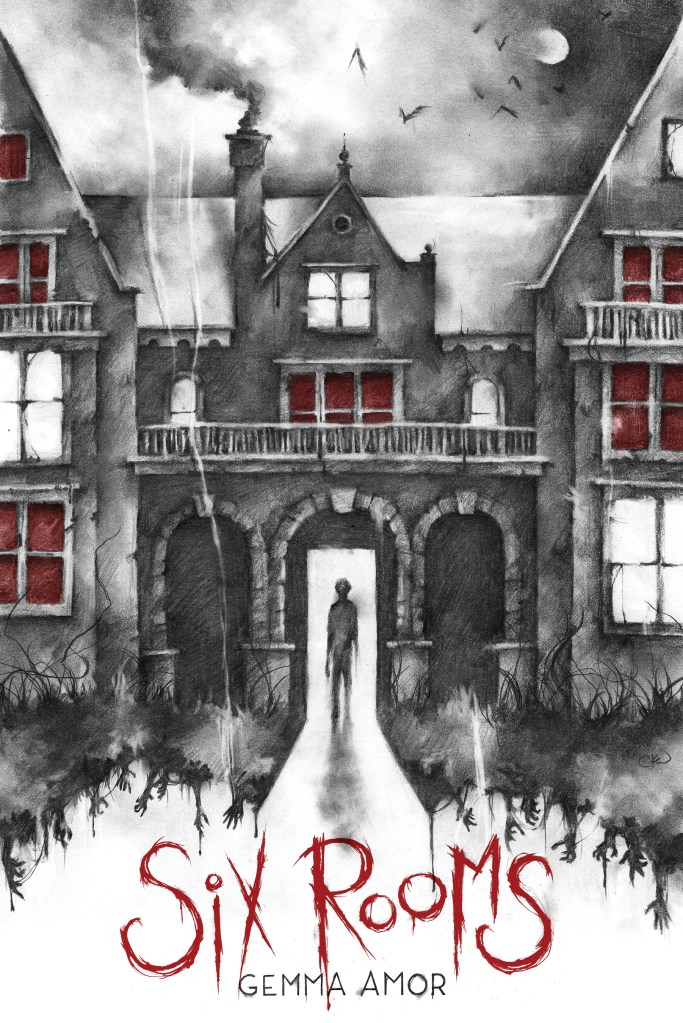
Six Rooms

Uncategorized

Released September 7th 2021. Order the ebook or paperback here!

Welcome, all, to the Sunshire Chateau: Lestershire’s premier tourist attraction. It sits high on a hill overlooking town, shrouded by tall trees and rumors of murder, scandal and intrigue. Tickets are hard to come by, so hold yours close, else the Tour Guide may not let you in. And that would be a pity, for there are so many things to see within these walls–history, glamor, and riches beyond your wildest imagination. Just remember the following rules: don’t wander off alone, don’t be rude to the Guide, and don’t, whatever you do, touch the valuables. 

Because the ghosts don’t like it when you touch their things. 

Bram Stoker Award nominated author Gemma Amor brings you her newest tale of secrets, lies, love, betrayal, greed, family ties, and a house that has seen a great many sights, over the years.

Praise for Six Rooms

Six Rooms starts as an almost whimsical ghost story but devolves inexorably into a series of genuinely dreadful horrors. This descent into violence and greed and regret will leave you thoroughly unsettled.”

Alan Baxter, author of THE GULP & THE ALEX CAINE SERIES

“Gemma Amor turns her keen eye for character and atmosphere to the nightmare land of ghosts—a gorgeous blend of historical horror and hauntings done right, Six Rooms is at turns chilling and heartbreaking, with enough scares to make sure you leave the lights on. A delight.”

Laurel Hightower, author of CROSSROADS & WHISPERS IN THE DARK

“Gemma Amor’s Six Rooms is a chilling ghost story that is full of her usual prose magic and haunting imagery. This deftly crafted paranormal yarn will chill the very marrow of your bones, whilst the frenetic pace and readability of Amor’s words will get your heart rate pumping until you turn that final page and can once more breathe easily. This is more than just a ghost story; this is a story about belonging, a story of finding one’s place in the world, but above all else it is a unique and masterful book that takes the paranormal trope and crafts something truly magical… Six Rooms will leave its mark long after reading, mark my words.”

Ross Jeffery, Bram Stoker Nominated author of TOME, JUNIPER & ONLY THE STAINS REMAIN
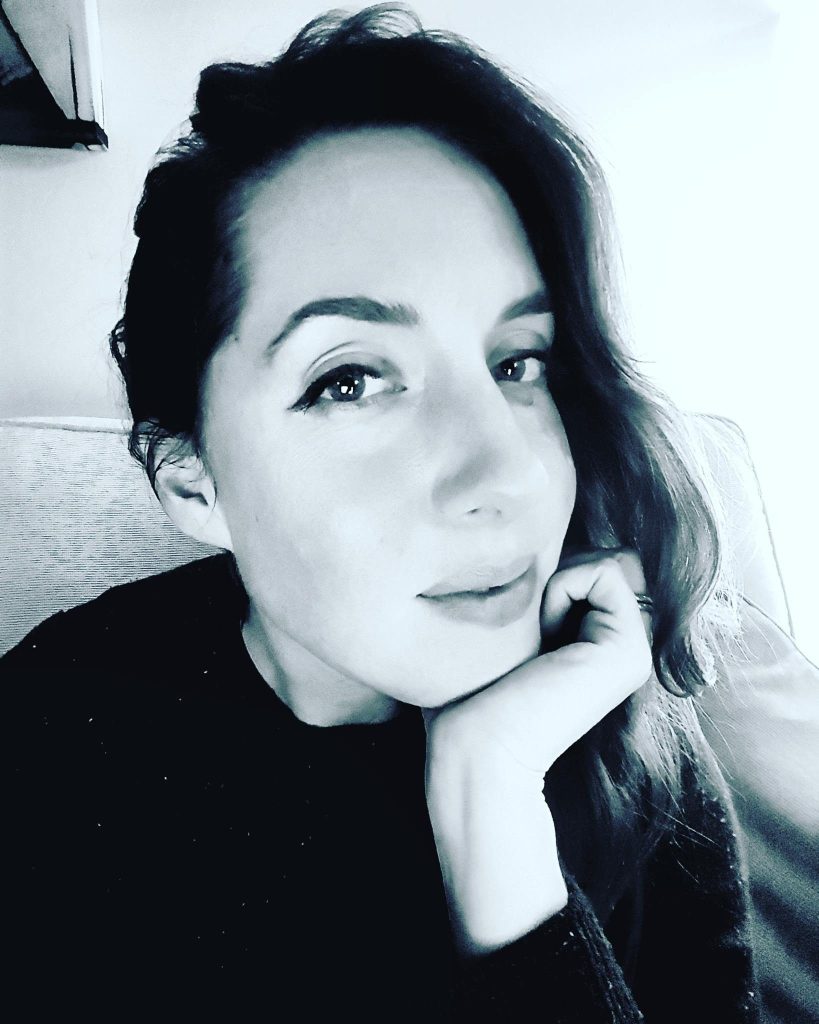

Gemma Amor is a Bram Stoker Award nominated author, voice actor and illustrator based in Bristol, in the UK. She self-published her debut short story collection CRUEL WORKS OF NATURE in 2018, and went on to release DEAR LAURA, GRIEF IS A FALSE GOD, WHITE PINES, GIRL ON FIRE, THESE WOUNDS WE MAKE and WE ARE WOLVES before signing her first traditional publishing deal for her novel FULL IMMERSION, due out from Angry Robot books in 2022. SIX ROOMS is her eighth published book. 

Gemma is the co-creator of horror-comedy podcast Calling Darkness, starring Kate Siegel, and her stories feature many times on popular horror anthology shows The NoSleep Podcast (including a six part adaptation of DEAR LAURA), Shadows at the Door, Creepy and the Grey Rooms. She also appears in a number of print anthologies and had made numerous podcast appearances to date. Other projects in development include a video game, a short film she co-wrote called ABASEMENT (2021), and more. 

Gemma illustrates her own works and also provides original, hand-painted artwork for book covers on commission. She narrated her first audiobook, THE POSSESSION OF NATALIE GLASGOW by Hailey Piper, in 2020–it won’t be her last.

New Voices in Horror with Eric Raglin

Uncategorized

Joe Sullivan: In the last year or so, I began listening to your Cursed Morsels podcast, checked out an anthology you edited: ProleSCARYet, and have read a few of your stories. Usually when I come across a writer who’s putting out quality work there’s more to their artistic history that I can catch up on–but you really seem to have emerged on the spec fic scene at some point in 2020. If I were to guess, I’d probably say you’ve been published elsewhere under a different name. Luckily, this is an interview and I don’t have to guess. So, Eric, what can you reveal about your interest in horror and how you began putting your dark fic out into the world?

Eric Raglin: You’re absolutely right about me joining the spec fic scene fairly recently. Before the pandemic began, I’d been writing horror and poetry off and on for several years (inspired by Livia Llewellyn, Carmen Maria Machado, and John Ajvide Lindqvist primarily), but I’d never submitted anything for publication. It was June of last year when I attended one of Gabino Iglesias’s workshops, and that experience inspired me to actually send work out into the world and start talking to people in the horror lit community. Now, with a few pieces published and plenty of new friends, I’m so glad I made that decision. 

You seem at ease with switching between narratorial voices and viewpoints from story to story i.e. man, woman, ambiguous, LGBTQ. This is fairly uncommon, as writers worry themselves over the authenticity of it all and don’t like the extra criticism it may bring. I’m really curious at what your process might be for choosing your narratorial focus. How do you choose which viewpoint best serves the story?

Writing provides an opportunity to explore new worlds and perspectives. I’d get bored if I wrote solely from the perspective of someone like me (i.e., white, male, bisexual, cisgender, etc.) That said, when I write from a perspective other than my own, I do my research and try to be mindful of stereotypes. I also make sure to give my characters flaws and complexities, regardless of their identities. It’s important that I not flatten out, sanitize, or caricature a character’s experience. As far as how I choose a narratorial focus for a story, I take time to consider which perspective would be most interesting, powerful, and fitting for the individual story’s needs.

Your debut collection Nightmare Yearnings is set for release in September, and it has been blurbed by some really fantastic writers. If someone reads it front to back, what do you hope they take away from the book as a whole?

I hope readers come away from the book with exhilarating disorientation, a troubled night’s sleep, and a mobilizing anger against the injustices of capitalism.

I think most who know your work, or at least know of you, are familiar with your interest in anti-capitalist, antifascist, and LGBTQ themes. What other themes are you interested in exploring through your writing?

One theme I come back to repeatedly is ecological destruction. Climate change is a collective trauma that we must process and confront however we can. One way in which I do that is through writing eco-horror.

What do you hope to do in your writing career after Nightmare Yearnings? Longer works? More short stories?

I’ve just finished my second weird horror collection Extinction Hymns, which I intend to submit to small presses over the next few months. Beyond that, I have a novella in my sights, but it’s too early to comment on what it might become. All I know is that short stories come much more naturally to me than longer fiction. Hopefully I can learn to write both.

………………………………………….

Eric Raglin (he/him) is a Nebraskan speculative fiction writer, horror literature teacher, and podcaster for Cursed Morsels. He frequently writes about queer issues, the terrors of capitalism, and body horror. His work has been published in Novel NoctuleDread Stone Press, and Hyphen Punk. His debut short story collection is Nightmare Yearnings. He is the co-editor of ProleSCARYet: Tales of Horror and Class Warfare. Find him at ericraglin.com or on Twitter @ericraglin1992.

On Editing and Writing With Wendy N. Wagner

Uncategorized

Joe Sullivan: You’re well-known in speculative fiction, as Managing/Senior Editor at Lightspeed and now as Editor-in-Chief at Nightmare. What was your path into professional editing?

Wendy N. Wagner: I started out as a volunteer! I had a friend who was volunteering as one of John Joseph Adams’s editorial assistants, and she realized he needed a few more hands on deck. Since I’d just sold him a short story (for his anthology The Way of the Wizard), he knew I was a decent writer, so he let me jump into a few anthology projects. We realized we worked together really well, so I just wound up sticking around.

If you have the time for it, volunteering is a great way to make connections and learn new things in this industry. When I first got serious about writing, I had a job, student loan debt, and a toddler, so going to a big workshop wasn’t remotely feasible. But I had an internet connection and a few hours every day after my daughter went to sleep. I used them the best that I could!

The second question in and I’m already going to ask you to expound on the nebulous. Genre fiction, especially horror, seems to thrive when an old trope is brought back and reimagined and reinvigorated by a group of talented writers for a brief window. Are there any current themes in horror that seem to be irrupting(or at least bubbling under the surface) in your inbox at Nightmare?

I’ve been working at Nightmare since 2014, and in that time I’ve definitely seen some trends in the genre. For some reason, between 2014 and 2019, sin eaters made a lot of appearances in the slush pile!

Strangely, I haven’t seen any serious trends showing up in the last six months. There’s been a small increase in vampire stories, I think, and of course a ton of evil mermaid stories (that’s the influence of Mermaids Monthly Magazine, a one-year-long themed project). I’m kind of hoping the success of Stephen Graham Jones’s novella The Night of the Mannequins and Netflix’s Fear Street trilogy might spark a resurgence in slasher stories. But you can never predict these things: I thought we’d see a zillion witch or historical horror stories after The VVitch came out, and that never really came true.

I personally think there’s been a thematic resurgence with the Faustian bargain. But it seems to have more of a self-sacrificial twist to it. You published a story with us last year, “The Deer God,” which to me is a great example of this–and I believe you’ve developed this story into your soon-to-be-released horror novel The Deer Kings? I thought the Deer God was a great character. Will he be returning in the novel?

Thank you so much for your kind words! “The Deer God” is one of my very favorite stories that I’ve written. And the Deer God himself is definitely my favorite monster. He’s so powerful, evil, and yet weirdly banal—like I love the fact he’s such a big fan of Rick Astley.

That Faustian bargain lies at the heart of both the short story and the novel, but the novel really looks at the concept both more broadly and more deeply. It’s the story of a man (his name is still Gary and he still loves to go running, but other than that, he’s a totally different character than the guy in the short story) who is forced to move back to his hometown when his wife gets her dream job. Once he arrives, he realizes that there’s a cult in town that’s worshipping a creature he and his friends summoned when they were young teens. Now he has to reconnect with his old friends and remember what kind of deal they struck with the Deer God—before the cult targets Gary’s family for their biggest and most dangerous ritual.

I’ve also seen a little bit about your Neon Hemlock novella The Secret Skin. Is it a ghost story? What can you tell us about it at this point?

The Secret Skin is definitely a ghost story! It’s a gothic tale set in the 1920s, about a young woman who goes back to her family’s mansion on the Oregon coast to help watch her niece while her brother honeymoons with his second wife. Of course, a lot of terrible things have happened in the house, and none of the characters are quite what they seem, so there’s lots of mysterious and spooky moments. If you like haunted houses and stories about families with dark secrets, it’s a book for you.

It’s not uncommon for a writer to take a break from writing as they become more in-demand as an editor. How have you managed to get your magazine work done and still have time to produce novel-length fiction? You’re certainly reading more contemporary horror as an editor–do you find that this is helpful for your writing?

Oof. Sometimes striking that balance is so hard. It’s so easy to let the magazines suck up all of my time, because there are definite deadlines and because there are so many people depending on me to take care of things. I could never let JJA down, for example.

For me what works is making a schedule and sticking to it. I like to get in some of my own work in the morning and then use the afternoon to focus on editing. I usually use evenings to read slush or work on author promotional stuff. I think I’m writing much more slowly now than I used to, but at least I’m getting a little bit done on most days.

I tend to take most of my inspiration from nonfiction and the visual arts, so reading a lot of new horror stories doesn’t really seem to stir up my brain. In fact, it can be really draining. When I’m reading a lot of submissions—and we get about 1200 when we open for our two-week submissions periods, which happen twice a year—I find myself quite tired and depressed and I struggle to get to any of my own work. It’s kind of terrible! I’m hoping I can find a way to feel better while I’m slushing.

Lastly, are there any John Joseph Adams editor tips or tricks you’ve picked up along the way that you can share?

JJA is an absolute wizard of titles! Just about any time we get a story with a title that’s only one or two words long, he will ask the writer to dig deeper and find a longer, more evocative story title. And a big part of that is because a title is really the only selling tool a short story has. Like books have covers and blurbs and back cover material, but most people will only ever see a short story’s title.

Coming up with an exciting title can be difficult, but John can always find some cool line in a story and tweak it until it’s the perfect title. I’m really trying to figure out how he does it!

…………………….

Wendy N. Wagner is the editor-in-chief of Nightmare Magazine and the managing/senior editor of Lightspeed. Her short stories, essays, and poems run the gamut from horror to environmental literature. Her longer work includes the novella The Secret Skin, the horror novel The Deer Kings, the Locus bestselling SF eco-thriller An Oath of Dogs, and two novels for the Pathfinder role-playing game. She lives in Oregon with her very understanding family, two large cats, and a Muppet disguised as a dog.

My Heart Stopped Beating But I’m Jonesing For A Fix

Uncategorized

by Alicia Hilton

Satan invites all of the wraiths for afternoon tea. Single file, we process from the cemetery. The elderly corpses lead the horde that trots, walks, lurches, and lumbers towards Lucifer’s mansion, the copper-clad turrets gleaming, windows winking at us, the shutters opening and shutting, opening and shutting, as if the house is more alive than any of us.

            Middle-aged corpses, like me, are stuck in the center of the pack where the air is thick and ripe, a sulfurous quagmire of humidity and decay.

            Desiccated codgers in front of me wield canes, but they are remarkably agile. Centuries spent in crypts are like marvelous sleep, you waken with more vigor than you ever experienced when you were breathing.

            The young tykes and infants stumble and crawl over each other as they try to keep up.

            All of the dead are surprisingly civil until Gertrude swings her axe and hacks Gerald, cleaving his forehead. The skull fractures, but nothing pours out except dust.

            With a triumphant shriek so loud that it smothers Gerald’s bellow, Gertrude swings the blade again—whack whack, she separates Gerald’s head from his neck.

            His grey eyes are blinking when the head rolls past me.

            A dead child kicks the cranium into the rose bushes, like a striker slamming a soccer ball into a goal.

            “Naughty, naughty,” the child’s mother says. She snaps off a branch from a rose bush and swats her son’s bottom until he wails, but no one punishes Gertrude.

            And no one except me seems to notice the cloud of mosquitoes approaching, buzz, buzz, buzzing.

            The black mass swirls, surrounding us. The bloodsuckers are as big as hummingbirds.

            A proboscis spears my elbow. When I swat the voracious creature, it sucks harder.

            Satan’s butler strikes a femur against the dinner gong.

            All of the mosquitos vanish, but I still feel their dagger mouths puncturing my flesh. Rows of pinpricks march up my arm, from the elbow to the shoulder. As the flesh is tenderized, my wrinkled epidermis swells and warms, and I begin to sweat. Seconds later, the pinpricks transform, becoming blisters, how very strange, the sensation is almost pleasant.

            The butler announces, “Tea is served.” He gestures for everyone to sit on the veranda.

            We shuffle forward.

            After what seems like an eternity, I reach the staircase. The worn boards creak under my weight.

            Lucky me, there’s one metal chair left on the southeast corner of the veranda, with a view of the melting glacier. I avert my eyes, not wanting to look at the emaciated polar bears, a reminder of how humans pillaged Earth.

            Across the table, my dining companions chatter among themselves. Sunlight illuminates their decayed faces.

            No one complains that the tablecloths are stained. The milk is sour, a bluebottle fly swims in the pitcher of lemonade, the almond biscotti is burned, and the scones are too hot for anyone to bite, so hot that steam rises from the currants. But why would we whine? We’re all jonesing for a fix. Mortification makes us as voracious as the mosquitoes, hungry for forgiveness, a chance for redemption from mistakes we made when blood still pumped through our veins.

            A three-headed chicken with fox feet serves deviled eggs, so tasty despite the wriggling maggots.

            Two Minotaurs wearing rubber aprons pour flaming shots of bourbon, but I don’t imbibe because spirits make me paranoid.

            The phantom sitting to my left says, “Pass the biscotti, please.” His voice is calm, nonchalant despite the rat feasting on his intestines.

            Another rodent skitters across the tattered tablecloth, dragging a sodden handkerchief.

            I wrestle the hanky from the rat. Ectoplasm smells like sex and betrayal. Inhaling deeper, I sigh.

            A woman that I killed materializes on the veranda.

            I rub the mosquito bites on my elbow and say, “Hello, darling.”

            “Miss me?” she laughs. In her left hand, she holds an aqua-colored bottle. The frosted glass reminds me of a beach vacation I took with my parents, when I was too young to realize that I was becoming a monster.

            But aren’t we all monsters?

            I hold out my cup, and she uncorks the bottle and pours poison in my sweet tea.

            The fiery liquid tastes like regret.

            My tongue bleeds, but I guzzle another mouthful. As the caustic concoction works its way down my throat to my gut, my former lover’s face morphs.

            I say, “Hello Satan.”

            The Dark Lord demands, “Pentagram.” The bottle in his left hand transforms, becoming a conductor’s baton. Waving the ebony stick, he directs us.

            Everyone—the young, the old, even headless Gerald, links hands and forms a friendship pentagram.

            Together we chant, babbling words that I do not understand.

            The young man clinging to my right hand has eyes like a goat and a flat nose that is more reptilian than human, but he’s a tenor with a lovely falsetto.

            The girl holding my left hand has sharp fingernails that slice into my palm, but the pain invigorates me.

            I gasp in surprise as I feel my heart restart.

            As we harmonize, our chant gets louder and louder, booming like thunder.

            Satan shouts, “What do you want?”

            I scream, “Forgiveness!” but my voice is drowned out from pleas shouted by the other dead.

            Satan says, “What do you need?”

            “Forgiveness!” I repeat.

            The ground vibrates.

            The trembling increases until the melting glacier splits, releasing an army of spiders.

            Arachnids race towards us, a flowing mass of black, brown, and red—thousands and thousands of spindly legs.

            My feet are frozen to the ground, and none of the other dead attempt to flee.

            Even corpses know that you cannot outrun fate.

            One, two, three, four, five, the seconds stretch, as if time has slowed down.

            Of course time has slowed down. Satan understands the power of dread.

            Spiders scamper up our legs. Higher and higher they climb.

            A tarantula bites my cheek, but I smile.

            In Hell, hope never dies.

……………………………………………

Alicia Hilton is an author, law professor, arbitrator, actor, and former FBI Special Agent. She believes in angels and demons, magic and monsters. Her work has appeared in Akashic Books, Best Indie Speculative Fiction Volume 3, Daily Science Fiction, DreamForge, Litro, Sci Phi Journal, Space and Time, Vastarien, Year’s Best Hardcore Horror Volumes 4, 5 & 6, and elsewhere. She is a member of HWA and SFWA. Her website is https://www.aliciahilton.com. Follow her on Twitter @aliciahilton01.

It’s Drama Time! Just Kidding, Let’s Talk Books!

Uncategorized

by Gabino Iglesias

Last week was rough. I started writing about tools you’ll need to succeed in publishing that no one told you about. Then I stopped before I was done and started writing a piece about a racist situation in publishing that made me angry. That was interrupted when I learned that someone had copied Sam Pink’s style and sold a novel writing in his voice for a lot of money. Obviously, I started writing about that. While writing those pieces for my next column, the only constant was that I kept reading and getting books in the mail I was excited about. Then it struck me: fuck drama; let’s talk books! Books are awesome. Books are medicine for the soul. Books are entertainment. As I keep pushing forward—and last week had a superb angle that I also wanted to write about but it involves things I can’t talk about yet—having books, writing, editing, reading, and teaching creative writing at the center of my life keeps bringing me joy, so I’ll share with you some authors that I discovered later in life that wished I’d discovered sooner. Hope you share some of yours with me later. Why? Because talking about books beats talking about drama any day of the week.

10. Henry Miller

Some consider the man a genius and others think of him as no more than a libidinous hack. For me, he masterfully walks the line between the two. His work is beautiful, deep pulp. His observations on art are art themselves and when he gets down and dirty, he doesn’t pull any punches. This duality is something I try to achieve in my work; to dance on that dividing line between what most call literary fiction and the blood, sweat, tears, and other bodily fluids of the genre gutter. Every time I find myself editing a paragraph in which I, to a degree, find that balance, I wonder how Miller’s prose would have helped shaped the malleable mind of a 14-year-old who desperately wanted to share his own stories.

9. Gwendolyn Brooks

Strangely enough, I devoured poetry as regularly as I did crime and horror in my early years. Oliverio Girondo, Mario Benedetti, Julia de Burgos, and Federico García Lorca quickly became favorites. Many years later, already living in the U.S., I encountered the poetry of Gwendolyn Brooks, online and almost by accident. Short, sweet, playful, and surprising in its depth, especially in her shorter poems, her work forced me to rediscover and rethink rhythm, to explore once again the way words can force you to read them a certain way because the author has infused them with the power to set the tone and cadence in the mind of the reader.

8. Jim Thompson

My crime education was packed with books by Elmore Leonard, John le Carré— whom I found a touch boring but read because his books were around—and James Ellroy, among others. Unfortunately, it wasn’t until I moved to Texas that I finally acquired a few Jim Thompson books. His work blew me away. His novels were full of violence, unreliable narrators, surprisingly odd structures, and bizarre inner monologues, but those elements somehow added up to outstandingly beautiful crime novels. I’ve always walked on the weird side of things, and have no doubt Thompson would have helped me land on the right path much sooner if only I’d been lucky enough to have access to his novels earlier in life. In fact, this is something I often also think about Charles Willeford and Chester Himes, but it happened with Thompson first.

7. Cormac McCarthy

I’ve written extensively about the backlash my bilingual fiction has received, and every negative comment or angry 1-star Amazon review that complains about the Spanglish always reminds me of my first encounter with McCarthy’s work. Here was an author who wrote using his own set of rules, and he was respected and lauded for it. To this day, his work, along with that of authors and academics like Gloria Anzaldúa, gives me the strength to push forward and write things they way they demand to be written and not like monolingual readers would like to read them.

6. Mayra Montero

For a long time, I thought of Mayra Montero as a journalist who wrote great articles and opinion columns for my local newspaper. I knew she was a writer, but had no interest in checking out her work. Right before moving to Texas, I decided to read In the Palm of Darkness (I read the Spanish edition, Tú, la Oscuridad), and quickly realized that she touched on many of the things that obsessed me: identity, language, mystery, and syncretism. It immediately made me wish I’d started reading her sooner. 

5. Langston Hughes

When craving the stunning beauty that can be found at the heart of poetry, I systematically evade purposefully convoluted poems and turn to the simple, straightforward poems of Langston Hughes. For any author reading and writing across genre boundaries, there are times when gratuitously embellished writing seems tempting. Similarly, dense writing may seem impressive to some. However, once you read too many weak, plotless, beautifully written books, it’s almost impossible to go back to that while ignoring how satisfying undecorated simplicity can be. I wish I’d learned that sooner, and I’m sure that would have happened if I’d started reading Hughes back when I was reading poets daily before my 18th birthday. In a way, the same goes for Charles Bukowski, but that’s better left unsaid because mentioning him nowadays only brings hot takes and insults.

4. Chuck Palahniuk

For years, Palahniuk existed in the periphery of my reading habits. That movie everyone has seen had placed him on my radar, but other books, lack of disposable income, and limited access kept his books away from me. Finally, I dug into his work, years after the aforementioned movie had come out. It was an eye-opening experience. I always leaned toward weirdness, and this man was the patron saint of it. If I decided to study journalism because Hunter S. Thompson was a journalist, I lost all fear of writing bizarre narratives because Palahniuk had been successful doing it. I regret not delving into his novels the second the movie ended and his name was in my head.

3.  Edwidge Danticat

There is a collective Caribbean heart at the core of every Danticat novel, and reading her work is a master class in how to tap into it. For those inhabiting Otherness, literature can be a weapon, a tool, and a home. I found all those things in Danticat’s work and, as a bonus, developed a little voice in my head that whispers “It’s okay, keep going” whenever I stop to think if my writing is becoming so tied to a specific identity or place that it might be alienating for readers. 

2. Patrick Chamoiseau

Chamoiseau, like Danticat, came to me late and thanks to my time at the University of Texas at Austin. Also, like McCarthy, he showed me that mixing languages was not only acceptable but sometimes required in the name of authenticity. 

1. Harry Crews

Crews changed the way I looked at fiction, my understanding of weird narratives and characters, and shaped a few of my views on writing, and he did all of it in the last ten years or so. Before I moved to the United States, I hadn’t even heard of Harry Crews. His name was one I came across when I started looking for better, stranger fiction that none of my cohorts were talking about. I found it quickly, and I became a huge fan of Crews even faster. It’s impossible not to wonder what twenty years of his words would have done to my brain.