Just Til Morning

Uncategorized

by K.S. Walker

“Hey Britt…you’re not gonna like this.”

Brittany pressed her eyes shut, for just a moment. Her shoulders ached, her blisters burned, and there was not a square inch of exposed skin that did not host the raised welt of a bug bite. Whatever waited for her at the campsite could not possibly be worse than what she felt right now. She pressed forward through the trees, and stepped into the clearing. Her heart sank.

The last three of their seven miles were made slow and torturous by the late season black flies and wet trail. They were supposed to make camp hours ago. Already the sun was dipping below the tree line.

“This place is trashed.” Brittany fought to keep the tears out of her voice.

Mikayla snorted while toeing the larger fragments of broken glass bottles together. “That is an understatement.”

Brittany dropped her pack and joined Mikayla in her appraisal of their site. The wind had torn loose pages from a newspaper pinned under a rock; wet circulars were plastered across the dirt clearing.  Brittany kicked a bottle of lighter fluid towards a punctured can of bug repellant. Several soggy rolls of toilet paper rested on a rolling cooler. An overturned camp chair jutted out of the fire pit. A rain-soaked tent obscured half the picnic table. Brittany picked at the pile of canvas, revealing the box the tent came in. ‘Sportsman 8 with Screen Porch and Dividers’.

“This was brand new. Who leaves this kind of stuff behind?” Brittany asked.

“Rich white people,” Mikayla shrugged. “No offense.”

Brittany rolled her eyes, “I’m only half white. And neither side is rich.” She knew Mikayla knew it, but Brittany couldn’t stop herself from saying it anyway. Both girls attended Camp Kalkaska on the same scholarship and had for the past six summers. They made a game of keeping track of who’s photo had made the most appearances in the annual fundraising newsletter. So far the score was Mikayla: 5, Brittany: 7.

Brittany groaned, “I do not want to clean this up. All I want to do is take my boots off, eat an under-seasoned dehydrated meal and take my butt to sleep.”

“Fine. We have to move the cooler though. We’ll leave everything else.”

On top of her aches, the trashed campsite, having to set up camp in the growing darkness, the abandoned cooler felt like just one thing too many. The last of her composure was peeled away and her tears came hot and choking.

“Remind me why we’re doing this again?” Brittany asked.

“Because we want to be junior counselors next year and junior counselors get paid $1500 for the season.”

Mikayla was quieter when she added. “And because they don’t think we can.”

And there it was, the truth of it. It wasn’t in anything anyone said directly. It was more in what wasn’t said that made it very clear that no one, not their head counselors, not their peers, expected either girl to apply for the position much less follow through the skills test.

It was Mikayla’s idea. One whispered from the darkness of their shared bunk bed. At first Brittany dismissed it. But sometime over the last year the idea burrowed into her and became her own. And as much as Brittany wanted the cash, she wanted to throw it in their faces even more. Not one, but two Black junior counselors.

“I’ll take care of the cooler, Britt. We can figure out dinner when I get back.”

Brittany nodded, wiping at her face.

Brittany stood stretching skywards. Then she did a slow circle, fully appreciating her surroundings for the first time. Three red maples sprouting gloriously grotesque burls lined the eastern end of the site. Between a gap in the trees she could see the Manistee River winding through the bottom of the bluff below them, wide and slow. Maybe things weren’t as bad as they seemed.

Maybe they wouldn’t have been if Mikayla didn’t return from her cooler dump asking the questions Brittany was happy to ignore.

“What the hell happened here?”

“Can you play detective while helping set up camp?” Brittany’s tone was snippier than she intended, but she had reached her capacity for stoicism two miles back, the last thing she wanted was a mystery to solve. She fished in her backpack and pulled out their campstove and two headlamps. She tossed one headlamp to Mikayla. “You don’t think the storm surprised them and they just dipped?”

“But they must’ve had a car, look at all this stuff they brought. Why not just throw it all in the trunk?” Mikayla said, slapping at an insect attracted to the light of her headlamp.

“Maybe there was a medical emergency and there wasn’t enough time. They might even come back for their stuff later.” Brittany swatted something winged out of her field of vision too.

Mikayla spat, “I swear to god, a bug just landed in my mouth. Where are all these coming from all of a sudden?”

“Goddamnit,” Brittany swore. “It’s our headlamps. They’re attracted to the light.”

“No shit. Why are there so many?”

Mikayla had a point. Brittany had spent six summers in the woods and had never had so many insects use her headlamp like the north star. She looked around and saw that the night was filled with fluttering moths. Brittany dropped the stove to swipe bugs with both hands. Her palm connected with something meaty. She stood from the table and ripped off her headlamp.

“I can’t do this, Mikayla. Forget dinner.”

“Listen…”

“Let’s just eat a protein bar and go to —”

“Brittany, listen!

“To what, Mikayla? That’s not funny!”

And then Brittany heard it too. Like slow strokes of sandpaper against itself. Brittany swung around searching for the source of the sound.

Then she saw it. In the spotlight of Mikayla’s wavering headlamp, the lump at the base of one of the red maples moved. The lump was shifting, separating as if to open a chasm to the hollow core of the tree.

The huge growth Brittany had mistaken for a burl lifted itself on pale, spindly, appendages and it fanned out mottled forewings to separate from the tree entirely. Brittany backed away slowly, unblinking. She wished she could unsee the creature. She couldn’t afford to.

The terror’s movements were not graceful. The creature listed through the air on ragged wings, its feathered antennae trembling.The large compound eyes gleamed when caught in the red light of the headlamp. Its abdomen was by turns patchy grey and glistening smooth.  And its mouth…its mouth was a ragged slash full of flat human teeth.

Brittany was beside Mikayla now, pressed against her. She bit her lips together to stifle a sob. Mikayla whispered, “There’s two.”

“Run!” Brittany moved when she felt Mikayla’s tug on her elbow. She stumbled but regained her footing and followed the bounce of Mikayla’s headlamp through the trees. They zigzagged down a narrow path. Branches whipped at Brittany’s face, her hands. Above her, behind her, she could hear that raspy buzz. It filled her head, vibrated her teeth.

“Down!” Mikayla shouted from in front of her. Brittany felt the tug of grasping appendages in her braids and dove. She landed hard on her right shoulder and rolled down a steep bank of gravel and sand until a downed tree broke her descent. They’d run right to the bank of the Manistee. Dazed, she looked around in time to see one of the moth creatures drop towards her, its six legs outstretched. Brittany covered her face with her arms and rolled. She heard a thud connect with a fleshy body, and another, followed by an enraged screech.

She looked up to see Mikayla hurling rocks at the creatures from the river’s edge. Brittany took the open Mikayla created and staggered towards her. They dove into the water together.

The cold was jarring, Brittany counted to twenty before resurfacing. She broke the surface sputtering out water from inflamed lungs. She grasped for Mikayla, and tangled their hands together.

“Look,” Mikayla said, pointing with her chin, “They won’t come in the water.” It seemed true. She hoped it was true. The two giant moths remained near— circling in their staggering, lilting way, but they weren’t coming any closer.

“But how long do we have to stay here? How long until someone comes looking for us?” Panic clenched at her throat. There were tears streaming down Brittany’s face and she was bleeding freely from a cut on her temple, but her face was too cold to register either.

“We don’t have to wait until camp comes for us. We just have to wait until morning, right?” Mikayla said.

“Just wait until morning?” Brittany repeated.

“Just til morning.”

Brittany pulled herself closer to Mikayla wishing she could ignore the buzzing and rustling of the terrors in flight above her. Just til morning. Brittany repeated to herself. Just until morning.

……………………………………………………………………………………………..

K.S. Walker writes speculative fiction. Their favorite stories include either monsters, magic or love gone awry. You can find them on Instagram @kwalker_writes.

The World Is Hard For Little Things

Uncategorized

by C. O. Davidson

Camp Rockaway Christian Camp. The horse barn. I check my watch, and according to Mickey, it’s now more than three hours after lights-out. The horses shift in their stalls, tails swatting flies, they chuff in their sleep. I’m squatting behind this mound of hay, waiting for you. You think you’re coming here to meet Missy again, our cabin counselor, and I bet you’re ready to say anything to get her top up and panties down. But tonight she’s fast asleep, easy as five Benadryl in her Diet Coke.

When I first noticed you, I’d been here a week, would be here the rest of July, my parents both working, and church camp being cheaper than a baby-sitter. The first week, I mouthed the words to “Amazing Grace” and bowed my head at prayers, thinking about my books in my room at home. The next Friday came and with it the new campers for the new week. Standing in the shade of the portico at the rear of the kitchen, hidden, eating a stolen Twinkie, I watched the bus roll into camp. That’s when you and two other boys’ counselors came around the corner, talking about naming the “freshest meat” when the girls stepped off the bus.

I mean, really, I wasn’t surprised. Just like home, all the kids and counselors here are like that: Christiany at the Public Times, the only times that seem to count. But when they think Jesus isn’t watching, they probably make Him want to puke in His name.

So I started following you, at first out of boredom. I spied on you spying on the girls taking showers, laughing at the kids you called queer, drinking your smuggled beers after leading evening prayers. No one was watching me, not the other campers, not our cabin counselor, not the youth minister or lifeguard or arts-and-crafts teacher, canoe instructor, no one ever missed me, this pudgy girl, covered in bug bites and acne, pealing sunburned skin. And you never saw me.

But I saw you. Who you really were when no one was watching your white smile and tan muscles at the lake or listening to your earnest testimony at chapel or you strumming “How Great Thou Art” around the campfire.

But then I really saw you.

The morning after a storm, I was on my way to the showers, early. I had to get there before any other girl might see me naked.

I saw you standing by the path, your back to me, looking down at a small, gray squirrel. The storm must’ve blown her from her nest. She was turning in a circle, blind, until she finally curled up like a fern. You squatted by her. I thought to help. But then you stood, and as I was about to call out, to ask if I could help, you smashed your boot down. Bones cracked. And I froze. Only the tail left intact. Terrified, I couldn’t move. But you never looked around, never checked to see if anyone saw you. You just walked away, pausing only to scrape the sole of your boot along the gravel path. You left a horrible smear of blood and fur behind.

I buried her and prayed. But never told.

Because everyone loves you. And you’re in college.

And I’m just a kid. An ugly, weird girl no one likes.

But tonight you’ll finally see me, and I’ll be a terrible cipher.

I sneeze. For the twelfth time in, like, two minutes. And my nose, it drips and itches. I rub it though my mask, actually more of a hood, made from a feedbag, cinched at my neck with a bit of knotted rope. Soon, you’ll see me. As stars collapse behind your eyes and pull you down into the hell you deserve, you’ll stare up at me in pain and wonder, and see only my blood-slicked bailing hook, swinging down, again and again and again, splitting you open.

I’m thirsty. And hot. And my left butt cheek is cramping from squatting so long.

And you’re late.

………………………………………………………………………………

C. O. Davidson is a founding member of the Atlanta Chapter of the Horror Writers Association. She co-edited the book Monsters of Film, Fiction, and Fables (2018), and her writing has appeared in Dark Moon Digest and is forthcoming in Dark Ink’s collection Generation X-ed. She is on Twitter as @colearydavidson.

The Sacrifice Table: Making Time to Write

Uncategorized

by Gabino Iglesias

Unless you’re a full-time writer, you have to make time to write. Yes, I said make. We all get the same amount of hours each day, and when you subtract the time we spend at work, the time we spend on the road, the time we spend on family, friends, and pets, and, last but not least, the time we spend on things like eating, showering, paying bills, and sleeping…well, time is gone.

I often see writers on social media complaining about the lack of time to write and their very next post is about how they just watched four episodes of their new favorite series in a row. Before we go any further, please understand three things:

  • This is an article in which I discuss a few tricks that might help you make time to write, which means I’m not telling you to never take days off or to not take care of yourself if you feel like you need to watch some true crime instead of writing.
  • Ultimately, you are the only person in charge of your time and you choose how you spend it, so this isn’t me telling you what to do.
  • If you read the preceding two points and still feel the need to argue, you will be ignored. Why? Because I don’t have time to waste on silly arguments.

Okay, so now that what we got those things out of the way, let’s get to the five little things you can do to make time to write:

1. Recognize that any time is a good time for writing

“You should write at night because yadda yadda” or “You have to wake up early and write before the day starts because reasons.” I’ve heard those two and many more. Everyone is right and everyone is wrong; whatever works for you is what works. If you find that early works for you, wake up and kill it. If you start at midnight and that works for you, awesome. I’ve done both. What matters is getting words on the page.

2. Accept you don’t need to have an elaborate/meaningful/theatrical writing ritual

Sit your ass down and write. You don’t need candles or music or coffee or tea or your lucky socks or whatever. I know some of you are mad at that sentence, but the reality is this: if you have half an hour to get shit done and you spend fifteen minutes on your ritual, you spent half of your time on things that didn’t put a single word on the page. If you feel like fighting, please reread the three points above and please wash your lucky socks from time to time. Or don’t, it’s your business.

3. Realize you can write a book in short bursts

When I started writing my next novel I was teaching four classes at a public high school, and MFA courses at SNHU, and had my usual writing and reviewing gigs, so sometimes the only writing I got done was with one hand while wolfing down lunch at school, or for twenty or thirty minutes at night when I was done with everything else. Sure, it was slow, but I managed to write about 40k words that way in a year. Not great, but something. Point is, it can be done.

4. Accept you have to sacrifice things

Yeah, yeah, go read the three points above again. Saying you want to write is easy; writing is hard. I don’t give a fuck about people who say they want something but aren’t willing to put in the work. If you have time to watch four episodes of something, you have time to write. If you have time to post a hundred selfies or pictures of your cat or memes, you have time to write. I’m not saying you have to write, okay? That’s up to you, but good luck selling a book you’ll never finish. If you really want something, you have to make sacrifices, and lounging around or napping for hours when you could be writing is something that kills many careers before they’re even born.

5. Come to terms with the fact that you will never have as much time as you want

This is true even for full-time writers. Responsibilities and deadlines pile up, baby! If you have two hours and you use them to write, you can’t use them to edit. If you use them to edit, you can’t use them to write. It is what it is, so be grateful that you got two hours of work in and start figuring out ways of getting two more.

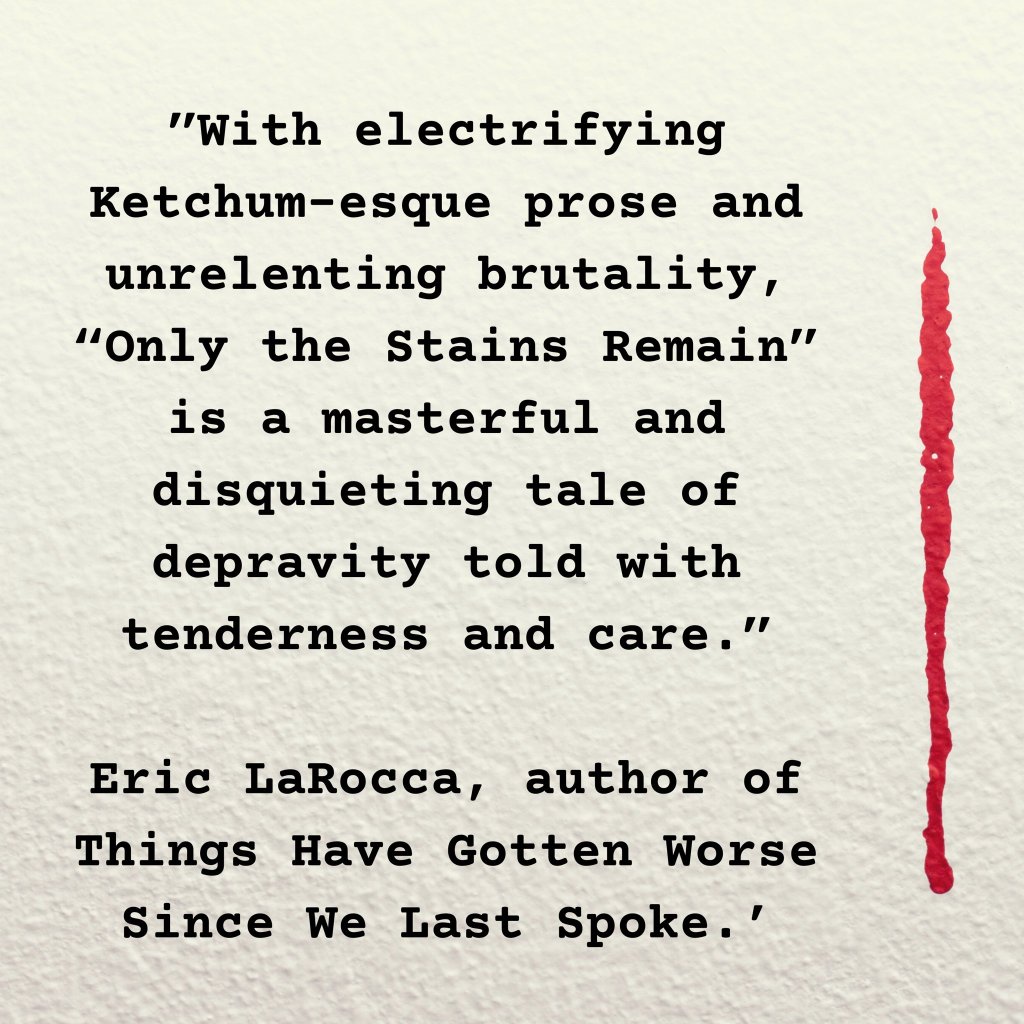
Only The Stains Remain

Uncategorized

Ebook and paperback now available here!

Jude is a troubled man, a man who is fighting the ghosts from his past, monsters of flesh and blood and bone. As Jude (aptly named by his mother after the patron saint of lost causes) reaches the lake, bloodied and out of breath – it’s clear that he’s running from something. But what?

In the calm vista that is before him Jude pulls from his shoulder his trusty satchel.

Within Jude has collected totems from his past, trophies from the monsters that haunted his childhood – macabre rewards of the revenge he’s enacted for him and his brother Kyle, each one is a memory, each one is a sacrifice, each one is a pain and torment realised and released – all of them a declaration of love for his brother Kyle.

At the water’s edge Jude begins to sift through the items and with each tainted artefact he is forced to remember his troubled upbringing, his childhood that caused him to grow up too soon at the hands of his abusive father and uncles – with their shield of protection gone, the beasts… they soon came to feed.

And so we wait under the weight of tragedy, suffocated by the brutality of childhoods lost to abuse and we wait for Jude’s final judgement.

Because after all is said and done; only the stains remain.

Ross Jeffery is the Bram Stoker nominated and Splatterpunk Award nominated author of Tome, Juniper & Tethered. A Bristol based writer and Executive Director of Books for STORGY Magazine. Ross has been published in print with with a number of anthologies. His work has also appeared in various online journals. Ross lives in Bristol with his wife (Anna) and two children (Eva and Sophie). You can follow him on Twitter here @Ross1982

Ten Tips to Survive Twitter

Uncategorized

by Gabino Iglesias

So far we have only talked about publishing in this space. However, the constant drama on Twitter over the past few weeks made me decide to use this month’s column to talk about social media and Twitter in general. Social media was part of my dissertation and it’s something I teach regularly, so while a lot of what you will read here could be called opinions, I assure you that they are educated ones and I offer them here in hopes that they will help folks navigate social media–which is to say I’m not trying to pick a fight with you, tell you how to behave on Twitter, or chastising you for anything you do with your platform. In any case, here are ten tips to help you survive Twitter:

1. Remember it’s not real life

Social media isn’t real. That’s why people always yell at each other and threaten to kick everyone’s ass. This means that most of what happens on it has no effect on your life. This isn’t to say it won’t ruin your mood or push you to take some time off social media, but it will rarely affect what you do with your day on a regular basis.

2. Accept that you won’t change anyone’s mind

Racists, homophobes, Ted Cruz stans, white supremacists; if it’s trash, it’s on social media. If you’re on social media, especially Twitter, you will encounter these people. Trying to change their mind is a waste of time. Would you try to explain to a Klan member why they’re wrong if you saw him at a coffee shop? Would you go to one of those events that are about how Trump will be reinstated in August and try to explain to the people there why that’s not happening? Social media is the same way; no one will change their mind because you have data or live a reality that proves their opinions are wrong, so don’t waste your time trying to do that.

3. Keep in mind that you don’t have to engage with anyone

You don’t owe anyone a thing. Your time and mental health are yours to enjoy and take care of, so only engage when you want to. I can’t stay quiet when I see certain things—racism, transphobia, sexual harassment—but there are plenty I shake my head at and ignore. That helps me keep my blood pressure under control. If someone is yelling about something on Twitter and you don’t care, you can ignore it and talk about something else.

4. Recognize that, to a large degree, Twitter is what you make of it

I’ve been called a spic and beaner, to name two slurs that have been present in my life since I started using social media. I’ve had a reading on Zoom interrupted by racists yelling slurs while I was trying to read. However, most of my interactions are with truly awesome people, positive folks who aren’t out to pick fights because it’s fucking Tuesday or sunny or raining, and amazing artists looking to share their work and the work of others. I choose to surround myself with good people, and that makes Twitter great almost all the time. Will you get the occasional asshole? Of course. Will drama land on your plate as you’re trying to do something else? You bet. Is the horrible side of social media always there? Yup. Can you stay away from it most of the time? Totally. Have you seen the news lately? All of that awfulness is happening in the real world, so it’s normal for it to crawl into social media, but that doesn’t mean you have to pay attention to it all the time or allow it to enter your space.

5. Learn to mute and block people

Remember those slurs I mentioned? Well, anyone who says that to me is blocked. I won’t spend six hours going back and forth with them on social media. Fuck them and fuck that. Any time I spend typing is time I will spend working on articles, novels, short stories, book reviews, or talking to friends and trying to support others. I don’t have time to waste, and people who throw racial slurs around don’t deserve a speck of my time. Block and mute people if they get on your nerves or insult you. Seriously, it’s good for your mental health and will improve your Twitter experience.

6. Accept that people are angry and a lot of them put all their anger on social media

Your tweet: “Good morning, folks! Have a great day.”

First response: “Fuck you! Don’t tell me what to do!”

Second response: “Who da fuck says ‘folks’? lol”

Third response: “You will have a great day if you buy my book! (insert Amazon link)”

Fourth response: (insert huge coffee meme)

Fifth response: “I always try, but I can’t because THE FUCKING GAY AGENDA WON’T LET ME!”

Sixth response: “Sure.”

You get the point. Do you and don’t pay attention to the anger that has nothing to do with you. If we’re being brutally honest, none of us are perfect and we’re all assholes from time to time. Some people will dislike you because of that and, in a way, that’s understandable. However, I lot of people will be angry at you because you seem happy or because you seem to be doing well or because you shared some good news or because you didn’t reply to their 2:15am dick pic or “hey” DM or because you look good in a selfie or because you took a picture of a pretty tree. Their anger is on them, so let them fester in it and soar high above that shit.

7. Accept that followers come and go

I’ve studied social media for a long time and teach it at SNHU and my own workshops. That means I pay a lot of attention from time to time. That also means I know that every action on Twitter has a reaction, and that reaction is often getting unfollowed. I lost dozens of followers because I shared a photo of a dead snapping turtle. I lose ten to twelve followers every time I tweet about how horrible Ted Cruz, Josh Hawley, Lauren Boebert, or Marjorie Taylor Greene are. I lose followers whenever I talk about diversity in fiction, which also fills my notification with hatred for 24-48 hours. Oh, and every time I support trans people? Mass follower exodus. Shit, sometimes I’ve gone to DM a friendly acquaintance on Twitter about an interview or to ask for a galley and learn they unfollowed me or blocked me. That’s okay. Followers come and go, so focus on doing whatever makes you happy and not on numbers.

8. Learn to take time off if you need it

FOMO is a real thing, but if being on Twitter or any other social media platform is affecting your mental health or keeping you from doing the things you’re passionate about, take a break. Seriously, unplug and do something else. It will all be there when you come back, the good and the bad, and you won’t miss anything more important than your mental health.

9. Internalize the fact that Twitter is part of the public sphere and what you put on it is for public consumption

One thing we spend a lot of time talking about in my workshops is the idea of privacy on social media. Anything you put out there, including DMs, can be made public in about four seconds flat. It’s okay to keep your religion, family, sexuality, hobbies, politics, or health private. There should be some stuff you enjoy and keep to yourself. You can talk about movies or gaming or books or music, but you can also keep some of that stuff to yourself and use it as a refuge when you take time off social media. Don’t want to share anything? That’s cool. I mean this: you don’t HAVE to be on social media. I know plenty of folks who aren’t, and none of them worry about it.

10. Self-care should be your number one priority

Social media is fucking insidious in many ways. You have to learn to combat that by focusing on yourself instead of focusing on it. Making friends is awesome, selling books is great, participating in certain discussions is illuminating and intellectual stimulating…but those things won’t happen if you’re constantly angry and frustrated and want to quit social media. There are many things that matter more than Twitter, so keep in mind why you’re there. Take care of yourself and who/what you love first and then spend whatever time you have left on social media. If it’s the other way around, you might need to rethink your priorities. You matter more than any platform.

The Embalming Room is Off Limits

Uncategorized

by Corey Farrenkopf

Lake hid beside the body-part sink. At least that’s what they called it. They didn’t know the specific term for the sink coroners employed to dispose of innards not destined for the casket. They didn’t even know if that’s what the sink was truly for. It had an opening in its basin large enough to stick two twelve-year-old arms down. What else could it be?

Lake knew this, testing the sink’s depths with Cashel and Mark one day after school.

“It hasn’t been used in years,” Cashel promised. “Just do it. Totally sterile.”

So Lake did, groping for whatever lay below, the cold cast-iron like a tunnel of ice.

“Wouldn’t they do something different with their hearts? Or their kidneys? Or whatever they put down here?” Lake asked.

“Probably now, yeah, but this place has been around since the 1800s. Who knows what weird shit they did with the leftovers.”

***

Lake tucked his sneakers in tighter to his body, trying to shrink himself as much as possible.

Lake and Cashel and Mark were playing hide and seek in the old funeral home Cashel’s mother was converting into condominiums. They usually avoided the embalming room, but Lake had a desire to actually see something, to not live strictly through second-hand stories.

When Cashel’s mother bought the historic structure, much of its previous life was left intact. There were coffins in the attic above the garage. Metal coffins for burials at sea. Wicker coffins woven into odd, pill-like shapes. Baby coffins, two feet long and inhumanly narrow.

Cashel’s mom sold them on eBay.

Each went surprisingly quick.

The first floor was a winding labyrinth of connected rooms, some with wide windows looking over Route 28, others with no windows at all. Most were carpeted in dull yellow swatches smelling of two-hundred-years of dust and the fresh paint recently applied to the ceiling. Electric candelabra stuck from the walls, an attempt at ambiance for grieving families. They’d been disconnected for some time, the wiring a fire hazard according to Cashel’s mother.

***

The sound of footsteps passed through the hall outside the embalming room. Lake held his breath, forcing limbs to still. The steps passed into the garage, across the cement floor, climbing the stairs to where the coffins once sheltered.

The coffin maker’s workshop lay between the garage and what was now Cashel’s bedroom on the second floor. That’s where Lake’s friends heard most of the noises, saw most of the figures wavering between one life and the next.

It always happened at night, they said. The hammering. The sound of a saw shearing boards. Mark had seen globes of light hovering above his sleeping bag, a dozen tiny eyes gazing down at him. Cashel had seen army medics carrying stretchers across the room, translucent bodies suspended between, fingers grazing the floor only to vanish through walls. They had dozens of stories, of sights and sounds divorced from reality.

But Lake had no stories.

His parents didn’t allow sleepovers.

He’d missed so much. The ghosts, yes, but they were only one item on a long list. There was the bonding time, the comic books, the video games played on a tiny tube television. Secrets shared. First crushes. Awkward, pre-pubescent moments. Shared dread. Shared joy.

Lake missed all of it once the sun went down. Maybe today he’d get a glimpse, he told himself, something to align what his best friends experienced, but he lacked. It would almost be like they hadn’t been apart, hadn’t had an extra degree of separation driven into their friendship.

***

The steps continued overhead, then there was the sound of a slap, skin on skin. Cashel had a habit of smacking whoever he found during the game, as if it was some unalterable rule.

“You dick, you don’t need to do that,” he heard Mark say above, his voice muffled by the floor.

“It’s the game buddy. If you’re going to play, you’re going to get slapped,” Cashel replied.

“That’s why it’s better when Lake searches. He doesn’t smack me.”

“I still haven’t found him.”

“I bet he’s outside in the bushes. He loves it back there.”

Then their footsteps drifted away, towards the second story deck and the outdoor staircase beyond.

The boundaries of their game weren’t limited to the house’s innards. The grounds were fair territory. A screen door slammed, then there was silence. Lake let out his breath, shaking his feet that had fallen asleep, pins and needles drifting through ankles. He’d won the game, but he wouldn’t show himself. There was a twinge of pride in outlasting his friends, but there was also the desire to regain something he’d lost.

He held his breath again, searching for the hammering, the saw, the sound of sandpaper over rough wood. Only stillness echoed back. Lake’s eyes darted around the room, searching for movement in the dim blue light filtering through the pulled curtains. Before him was the metal dissection table, the glass fronted cabinet that once held chemicals. There was a chair, a bookcase, a pile of paint cans and foam rollers ready for the next step of renovation. No figure reclined in the chair. No thin man wandered about his duties, slicing and stitching whomever lay upon the table.

Lake could imagine each flicker of translucent skin, each flash of the unseen, but they refused to playout before him. He would never get to know what his friends had seen, to know if they were being honest or messing with him. It’s what he feared, an inside joke he could only view from a distance, through closed windows and locked doors.

Tears climbed his throat, nudging his sinuses. He couldn’t let them come, not when Cashel and Mark would find him soon, all red eyed and puffy. He swallowed hard and swore, accepting his lack, accepting the distance.

Another door slammed out front. Footsteps tracked towards the embalming room, cutting through halls and viewing rooms as if all other hiding spots had been exhausted. Lake stood from his cavity besides the body-sink as Mark and Cashel pushed into the room, dull blue light washing over their faces.

“I thought we promised not to…” Cashel dropped off.

Mark said nothing.

Lake traced their wide eyes to the sink at his elbow, to the silhouette of a man standing over the wash basin, back to them, the flush of water reverberating in the pipes, something seething beneath their feet.

They were together, frozen in place, a moment shared, a question peeled back, the punchline of a joke never spoken.

“Finally,” Lake said as the man shut off the sink and turned to the friends, arms outstretched, something beating clenched in his hand.

Emmet

Uncategorized

by Mark Allan Gunnells

Abagail moved slowly and silently through the dark rooms. She’d never been in the Wood mortuary before. Her family had always used Living Waters because they understood the rites and customs for Jewish funerals. Abagail would never have guessed the first time she would step foot in the Wood would be after midnight, after she’d broken in through a back window.

Of course, she could have come tomorrow for Emmet’s service, but she would be a stranger to everyone and there may be uncomfortable questions about how she had known Emmet. She could make something up, say they were acquaintances from the gym, but what if some of the other people there knew him from the gym? She couldn’t exactly tell people that she had been Emmet’s secret lover for the past year and a half. No one in his life knew anything about Abagail, and no one in her life knew about Emmet.

So she had to do all her grieving in private, behind closed doors.

Of course, she had no one to blame but herself. Emmet would have been happy to tell everyone, but Abagail had been afraid. Afraid of what her family would think of her being with a man who wasn’t Jewish. Ridiculous, she was a grown woman who had always considered herself more of a cultural Jew than a practicing one, and yet she had let that stand in the way of embracing the healthiest relationship she’d ever had.

And now it was too late.

Unless…

She stumbled around the mortuary in the dark, wishing she could turn on a light but not wanting to risk it being seen from the street. It took her almost half an hour to find the stairs that led down to what she assumed would be the embalming room if this place was set up anything like Living Waters.

The utter unrelenting dark she found herself in at the bottom of the stairs told her there were no windows here so she felt along the walls until she found a light switched and flipped on a bank of harsh overhead fluorescents. She had braced herself for the possibility of seeing bodies laid out, but of course they wouldn’t leave them out overnight. They were probably stored away in an industrial freezer somewhere. There were cold metal tables next to the embalming equipment. She had watched enough Six Feet Under to at least recognize some of it. Luckily, unlike the show, the Wood Mortuary was not a family business where the family actually lived on the property.

It took her only fifteen minutes this time to find the closet that housed what she was looking for. On one side was a shelving unit that contained a variety of different urns, and on the other shelving that was mostly empty but for a few small square boxes with names on the front.

Cremains. That was what she believed they were called. The ashes of a person who had been cremated.

Like Emmet had been cremated.

Tomorrow his family and friends would have a little ceremony then take his ashes away, sprinkling them in the ocean or off a mountain or in the forest. Wherever they thought would be special to him. A ceremonial goodbye that might help them move on because they got to do it in public, acknowledge what he meant to them, not have to live with the guilt of being too ashamed to really be with him when they’d had the chance.

She quickly scanned the labels on the boxes, and Emmet’s was the second name she found. She took the box and held it close to her chest, as if she could hold on to him in death as she had never done in life. She thought about the last time she’d seen him. He’d spent the night at her house then got up the next morning to get ready to go to a family reunion. He’d asked her to come along, to meet his family, and she’d refused. Then he’d gone off and had a heart-attack in the midst of his clan.

She’d never get the chance to truly say goodbye. She’d never again hear anyone call her “Gail.” Her family all called her Abby, but Emmet had always insisted on “Gail.” And now that was gone.

Unless…

Still clutching the box, she quickly left the mortuary.

*

It had rained earlier in the day. Whenever it rained, her backyard turned into a muddy swamp. She walked out into it in her bare feet, the sticky mud squishing between her toes. It actually felt cool and she liked the way the soft ground tugged at her feet with each step. In the middle of the yard, shielded on one side by the house and the other by the large privacy fence, she dropped down to her knees, heedless of the filth splashing up all over her. She was about to get filthier.

She set the large twelve quart stock pot she’d brought with her to the side, placing the box with Emmet’s ashes next to it. She started scooping up large handfuls of mud and depositing them in the pot until it was halfway full. Then she tore open the box and the bag inside, working quickly so she wouldn’t have time to change her mind, then dumped the contents into the pot as well.

Closing her eyes and taking a few deep breaths, she stuck her hands into the pot and began kneading the ashes into the mud, like kneading breadcrumbs into ground beef when making meatloaf. She did this for several minutes until the ashes were thoroughly incorporated into the mud.

Then she dumped the mess out onto her lap and began shaping and forming it with her hands. She was no sculptor so the form was crude, like a child’s stick figure, but she thought it would at least be recognizable as the shape of a man. Two legs, a torso, two arms, a round blob of a head. Even some small bits between the legs.

As she worked, she thought about how insane this was. Yes, her grandmother on her father’s side had told tales of Jewish magic and golems, but they were surely just that. Tales. Stories. Myths. Yet a couple hours of Googling had provided her with a wealth of information on the practice. Still, the information was in fact presented as myth.

But grief will make you do funny things, she thought as she used her fingernail to carve the word “Emet” into the form’s head. The Hebrew word for truth. She then bowed her head and said a prayer, utilizing words from the Sefer Yetzirah, ending not with “Amen” but “Avra K’davra.” I create as I speak.

The form was already hardening and she laid it in front of her, thinking that if by some insane miracle this actually worked, it still wouldn’t be Emmet. Not really, not fully.

But maybe it would be close enough.

She closed her eyes and waited. After a few minutes, she heard a soft soughing breath. Could have been the wind, but in the sound she thought she detected a single word.

Gail…”

An Angry Man

Uncategorized

by Ali Seay

He’d been eavesdropping again. Gregory stood there in the stark hallway as the daughter of the dearly departed talked to Mr. Moore.

“My father was an angry man. If a person could physically embody anger—it was my father.” A sniffle. A light blowing of her nose. “I don’t mean to sound derogatory to my own family.”

Mr. Moore—a pro at this—had tsked her worry away. “Of course not. Not at all.”

“But after years of the cancer, the pain, and the treatment. My God, that toxic cocktail of chemicals they put inside him. I can’t even—”

A wave of her hand. Another soft blow into the tissue.

Moore: “It is difficult.”

“Then of course the cost of being a living science experiment. By the end, he was just not himself. He’d become a very angry person. I am almost—” She sighed mightily. “I feel bad saying this, but I feel he will find a purifying peace in being cremated. For most of his life he wanted to be buried, but then in the end he told me he didn’t care. To do what I wanted.”

“You were his advocate and daughter. You’ll carry out his wishes,” Moore said with his warm butter voice.

The daughter nodded. “I feel like my only relief will come with his complete rest. I’ll scatter his ashes where my mother is buried.”

A nod from Moore and then Gregory had drifted off, light on his feet as always. Back to his embalming room and the soft camaraderie of his clients—the dearly departed.

When it was time for the father, Michael McDermott, to be prepared, there was no need to cut into him. But it was well after hours by then and no one in the building but Gregory and it made him happy—the cutting.

“An angry man, I heard,” he said softly, slicing into the meat of Michael’s chest.

He liked the clean line that appeared, the whisper of the scalpel.

He’d broken the breastplate open and turned away for a moment when he heard the first sly sound.

Gregory froze. Then he laughed. It wasn’t unusual to hear things that weren’t there. It was an embalming room. It was late at night. And even he, completely at home with the dead, psyched himself out from time to time.

Gregory whistled. He whistled the opening song of that old black and white show he’d watched as a kid. A jaunty tune.

But when he paused, he heard it again. A slippery but dry sound. A seeking sound?

He turned in time to see a leg? A tentacle? A finger? None of those really but the insinuation of one or all of them.

Gregory choked on his own spit and took a step back.

This time four of them peeked out of the wound. Black as night and somehow hard looking. Like obsidian. They wiggled and danced before pulling up a long cylindrical body. It reminded him of a bullet. But the bullet moved and produced four more long thin wicked looking legs. The thing blinked at him. Then it let out a sound much like an air raid siren but in a higher pitch. An enraged sound.

My father was an angry man…

Gregory clutched his ears and gagged, the sound was so intense. It hurt him. His ears, his jaw, even his teeth seemed to sing.

Taking another big step back, he collided with his stainless-steel implement tray and it banged to the floor. Tools and tape rolling around on the floor like spilled party prizes.

“Jesus!”

It moved fast. It skittered slick and vigorous, reminding him of a silverfish, which made his stomach turn. Very few things grossed him out. Silverfish did the trick.

It moved toward him like an oil slick. It’s body an arrow keeping its course.

“No!” he yelled.

Gregory turned and fled the room. But then as he got to the end of the hall he realized that if he was moving fast and breathing hard he couldn’t hear. That thing could go anywhere. Be anywhere.

It was small enough and fast enough and mean enough.

He froze. Standing there scanning the ancient tile. Cracked, faded, dirty in some spots,  but no jet-black death bug. No anger vermin.

Cancer incarnate? Toxic cocktail reaction? Comic book radioactive side effect? Gregory didn’t know, and he didn’t care. He darted out the double swinging doors into the main area where the coffee pot, water cooler, and break table were.

He flipped the light switch. They came on reluctantly. Jumping and jiving in the ceiling making him feel like he was in a bad horror movie.

Then they were on and it was too bright.

“I’m sorry,” he said aloud to no one. Or maybe it was the bug he was talking to. Or Michael McDermott. Whatever. “I’m sorry I cut into you. That was wrong. I should have just…”

He heard something and shut up. He studied the baseboards, the tiled wall, the place where the coffee pot was plugged in. Hadn’t he read that bugs liked electricity?

He saw nothing.

Another slither-sliding-dry leaf sound.

He blathered on, walking slowly as he took in his surroundings. “I should have just prepared you and burned you the way your daughter wanted. I didn’t want to provoke your…” He cocked his head, ears searching for sound. “Anger. Your wrath. Whatever.”

He was in the dead center of the room now and heard it again. The urge to pee was overwhelming. The hair on the back of his neck stood on end as if some many legged thing already scurried there.

His ears did their job and pinpointed it. He looked up. Directly up above his head where the light fixture hung unassumingly.

And there it was. Black as void but somehow shiny, mouth opening, that air raid siren song, and when it dropped on him—that’s when he saw the stinger.

Wickedly long and dripping with wrath.

Gregory thought, I should have just burned him.

New Voices in Horror with Corey Farrenkopf

Uncategorized

Joe Sullivan: I know you’re a lit guy and a poetry guy, but you’re definitely a dark lit guy, too. You have an impressive lineup of dark fic stories on your resume. What keeps you coming back to the dark art? What horror media inspires/has inspired your creativity?

Corey Farrenkopf: I do live between a lot of genres these days…but most of them, if not all of them, end up being on the darker side. I’ve been on a big dark fantasy kick for a while now, which is always fun. As far as what keeps me coming back to it, I don’t think I have much of a choice. All of the ideas that come to me are definitely macabre. I’ve tried to write uplifting stories, or more humorous stories, but something usually seems off about them…or they turn dark anyway. I usually try to address something going on in the wider world, and most of what is going on out there is dark…so I can’t really get away from it. I often focus on environmental issues, so that’s not a particularly bright topic either…though I wish it were.

As far as horror media that has inspired me…that is a long list. For movies, I’ve loved Tim Burton’s work since I was like four years old. Guillermo del Toro is probably my favorite director out there, and everything he does, whether it’s a fairy tale, or sci-fi, or a coming of age story, it’s always dark. I’ve loved a lot of the newer horror movies coming out like Hereditary, Get Out, Suspiria, If Follows, The Lighthouse, and Mandy. Somehow I’ve missed a lot of the classics though, so I’m trying to catch up there. On the literary side, I love the work of Laird Barron, Caitlin R Kiernan, Nathan Ballingrud, Jeff VanderMeer, John Langan, Livia Llewelyn, Paul Tremblay, Stephen Graham Jones, Gemma Files, Andy Davidson, Brian Evenson,  Kelly Link, and Karen Russell. Those last two straddle a billion genres, but definitely have several stories that fall squarely onto the horror spectrum. And finally, I always like to mention Daniel Danger on the physical art front. He does these prints of crumbling buildings and rotting forest-bound architecture that really speak to me. If you haven’t checked out his work, definitely give it a google.

You were the only writer with two stories in Campfire Macabre, so I was familiar with your stuff, but I think it was “What Friends Don’t Tell Friends About Basements” from Bourbon Penn that made me stop and think, ‘Oh, Corey’s really focused on the short form.’ Even better, I find out you run discussions and seminars on flash fiction, so you’re really a specialist. This stands out to me, because it seems there’s this race to go from a few pub credits to a story collection, to a novella/novel, in order to check off a few boxes of what it means to have a writing career. I don’t know if you want to speak to it, but I’m curious if you’ve had a strategy for your writing? Because I think you’re an excellent example of a writer with a solid foundation.

I’m really flattered by that. Thank you. I’ve kind of had a weird trip when it comes to my publishing career. During my undergrad, I took a year long intensive writing course to complete a specialization in Creative Writing. While I was taking it, I asked everyone I could find how to make a career of writing, and between different professors, visiting writers, and a ton of articles, I was basically told there were two options. Either you write a really good novel, get an agent, then they get it published. Or you write a bunch of really great short stories, an agent will notice them and reach out to you, then they take the novel (that you hopefully have already written) and get it published. So that was my starting point. I pursued both roads and managed to get my agent, Marie Lamba, on the strength of one of my novels. Right now, we’re working on edits for a different novel. Years ago, I knew nothing about the small press world, so I only thought there were two options, so that’s how I planned things out. Because of this, I’ve always put a lot of emphasis on my novels in terms of pushing my career forward…more like something I really really need to do as a requirement…but because of that, short stories became something I did/continued to do out of love. I really enjoy the challenge of writing novels, but I get my true joy from shorter works.

With flash fiction, you get the challenge of restriction, but you also get the freedom to create outlandish plots that couldn’t be sustained for longer than a thousand words. It’s one of those forms where, after reading enough of it, you can see all the little moves and flourishes a writer makes and really appreciate the conscious effort that goes into it. This is why I teach flash classes at the library where I work. I also think it’s a less intimidating structure to get into for first time writers (who I work with a lot in these classes). Give someone the option of writing 80,000 words or 1,000, I think they’ll usually choose the latter.

But back to my career strategy. All of my longer works, mostly novels, have always been Horror or Dark Fantasy. My short stories weren’t always like that. Now that I’ve been honing in on what I want to do as a cohesive style, I’m discovering more places that publish Weird/Horror/blended-genre fiction, tracking open anthology calls, learning from what other authors in my adjacent genres are doing, and seeing where I fit into all of it. I love the challenge of themed anthologies. I love the hard deadlines. I love the chance to be published alongside other authors I admire. I love the chance to be part of a community. I view every short story acceptance as a small piece of bone in the spine of my overall body of work. When my agent subs my novels, it’s good to have a solid list of publications to use as a proven track record, it shows that you aren’t a one story/book kind of writer, who (hopefully) has many other stories/books ahead of them. That’s how I look at it anyway.

If anyone ever has any questions on this sort of stuff, I’m always happy to talk over Twitter. DM’s are always open.

Your flash ideas (stories under 2k words) are consistently creative and well executed. This type of short story is really the legacy form of horror to me, it’s what I’ve been reading since I was a kid. What parts of the formula can you share with aspiring horror flashmasters? Do you have any tips or tricks that serve brevity, the twist?

I’m always a fan of the weirder the better, so that’s one of my favorite things to nudge people towards in flash. Like I said above, you can get away with certain moves/twists/premises in flash that might not be sustainable for a 5,000 word story, let alone a novel. Flash also allows you to play with tropes in a very immediate way. You can spin an unusual haunted house tale with a few good introductory descriptions to anchor the atmosphere, and then role from there. Longer passages aren’t necessary to establish what we are familiar with/already know, so you can be more playful with it, in my opinion, in this form.

As far as advice goes, basically cut everything that isn’t necessary. Find your “weasel words” as Matt Bell calls them and kill them off. Dialogue really needs to serve its purpose in flash, so make sure all of it either pushes the plot or expands the characters. You can’t really think of a couple of lines as a lead in to the real meat of an interaction…it has to be all meat (or tofu if you are a vegetarian). Quick anchoring is necessary. Give readers something they’re familiar with, then get running. I often do this through setting. I know a lot of advice says to start with action, but I often start with setting/atmosphere for a paragraph or two, make that establishing shot, and then let the plot move from there, all encapsulated in this established world. Either that or one of my characters (or the 3rd person narrator) makes a shocking/interesting statement about what is to come/some odd character trait, and then the story begins. Both ways work well for me, but they might not for others, which is why Flash is great. You can do so many different narrative moves, approach the writing from so many different angles, and because you have limited word space, it takes a bit of the pressure off to “do it right.” (When I say “do it right” I’m mostly referring to standard story arcs, rising/falling action, etc…).

As far as twists go, I’m always a huge fan of the question Will it be supernatural?/Will it be realism? Sometimes that might feel a little Scooby-Dooish, but I love it. If you’re able to pull it off on either end of the spectrum, it will be my jam. So, for example, I have a story called Exorcism published in Monkeybicycle a few years ago. It’s about a young woman who pretends to be an ordained exorcist to help pay her student loans. The whole story builds to a final encounter, where, hopefully, the reader wonders, “will she actually be encountering a person who is possessed or will there be a different explanation, and what does that say about our world.” I won’t ruin the ending, but I love using this structure in my flash and I love to see it done in other people’s work. A good example of this is Pedro Iniguez’s story Caravan in Tiny Nightmares. It’s perfect. Definitely check it out if you can!

And the final thing I’ll say on Flash is sometimes it expands naturally and you shouldn’t fight that. If your story wants to be 3,000 words, try not to wrangle it into 1,000 words. Sometimes this can work, but sometimes it feels too clipped. I’m trying to be better at this myself, letting my stories be the length they need to be, which can be hard with word count restrictions from different anthologies and mags. Trust in what you’re doing and let your stories be what they want to be… and if you really need to make that word count for an anthology, try to chop out an entire scene or start the story further on…maybe that opening paragraph wasn’t what you actually needed…maybe the whole story actually starts on page two?

The opposite also works. Maybe you wrote a 5,000 word story that doesn’t work. What is the bare bones story there? Can you write that instead (usually from scratch) and see what shape it takes? Maybe that whole story only wanted to be a singular scene and that’s where the actual story lies? I’ve done this several times and have come away with awesome results.

I know you’re working towards your own books, that you have a few novella and novel-length stories in mind. Can you speak to the themes you hope to explore with your longer works?

Of course. I focus most of my efforts on the issues I see around me on Cape Cod. I’ve lived here for most of my life, so I’m very concerned with the environmental and economic issues that face the region and the people living here. The novel I’m working on deals with potential environmental collapse, despeciation, global warming, land conservation…but it’s also a love story…it’s probably mostly a love story if I’m being honest…and a bit of a cryptic, almost gothic, family saga. It’s definitely Weird fiction, with a bit of a literary thriller/slasher element going on, and it’s very supernatural (again, my stuff ends up living between so many genres).  I’m a big fan of nature writing, so there are a ton of descriptions of the landscape and the species that inhabit it…and the other things that inhabit it…but I can’t talk about them, it would ruin the surprise…whenever that happens.

At some point I’ll hopefully have a short story collection that revolves around those same themes as well. Right now, like I said before, my short stories are all over the place, and the cohesive themes aren’t perfect. At some point they’ll align. That’s what I tell myself anyway 🙂 Thanks so much for the thoughtful questions! I really appreciate everything you guys do over at Cemetery Gates Media to promote new voices in Horror and all of the awesome dark Flash you put out. All horror writers should keep an eye out for your open submission calls!

Corey’s website

Follow him on Twitter

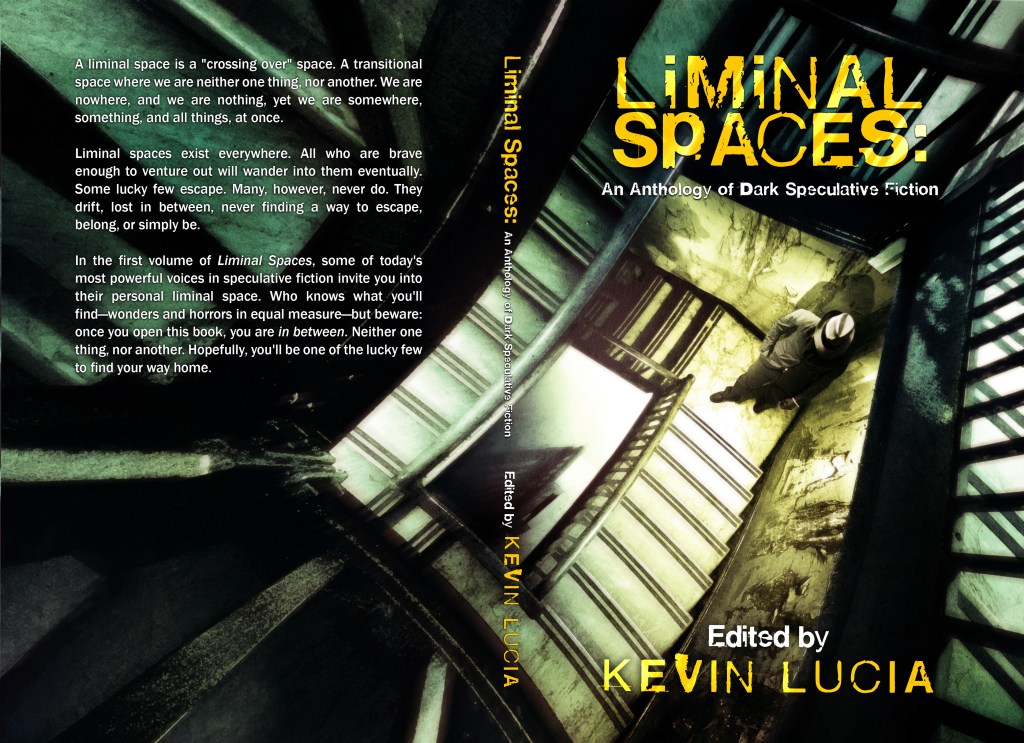
Liminal Spaces

Uncategorized
Cover art by Ben Baldwin

Horror anthology now available here!

“The word ‘liminal’ comes from the Latin root limen. It means ‘threshold.’ A liminal space is a ‘crossing over’ space–a space where you have left something behind, yet you are not fully in something else. It’s a transition space.

“This is my favorite kind of horror and speculative fiction. Fiction which takes place in that ‘crossing over’ space. Stories about characters who have–wittingly or unwittingly–crossed a threshold. Those who have left something behind, yet are not quite somewhere or something else. They are in-between, and are neither one thing, nor another. Classic anthologies like Shadows, edited by Charles L. Grant epitomize these kinds of stories, as did Rod Serling’s The Twilight Zone, the work of Charles Beaumont and T. M Wright, Joyce Carol Oates, Shirley Jackson, and the ‘strange stories’ of Robert Aickman.” -Kevin Lucia, Editor

Liminal Spaces is due to be released in September 2021 from Cemetery Gates Media, edited by Kevin Lucia. The anthology will feature many of the craftiest writers in speculative fiction today, trying their hand at the more subtle haunt, the whisper of the weird.

With stories from:

Gwendolyn Kiste “The Haunted Houses She Calls Her Own”

Bob Ford “Written in Water”

Joshua Palmatier “Mirror, Mirror”

Mark Allan Gunnells “Phoenix”

Kristi DeMeester “The Animal of Our Bodies”

Todd Keisling “Midnight in the Southland”

Chad Lutzke “Womb With a View”

Richard Thomas “Rotten to the Core”

Michael Wehunt “O Adelín”

Anthony J. Rapino “The Black Door”

Joe Koch “Reverend Crow”

Norman Prentiss “Cabinet People”

Jessica McHugh “Back to One”

Kelli Owen “Sharp Echoes”